

Most lists of digital marketing tactics online share the same flaw. They hand you ten things and imply you should do all of them, as if content marketing and setting up a LinkedIn profile belonged in the same column.
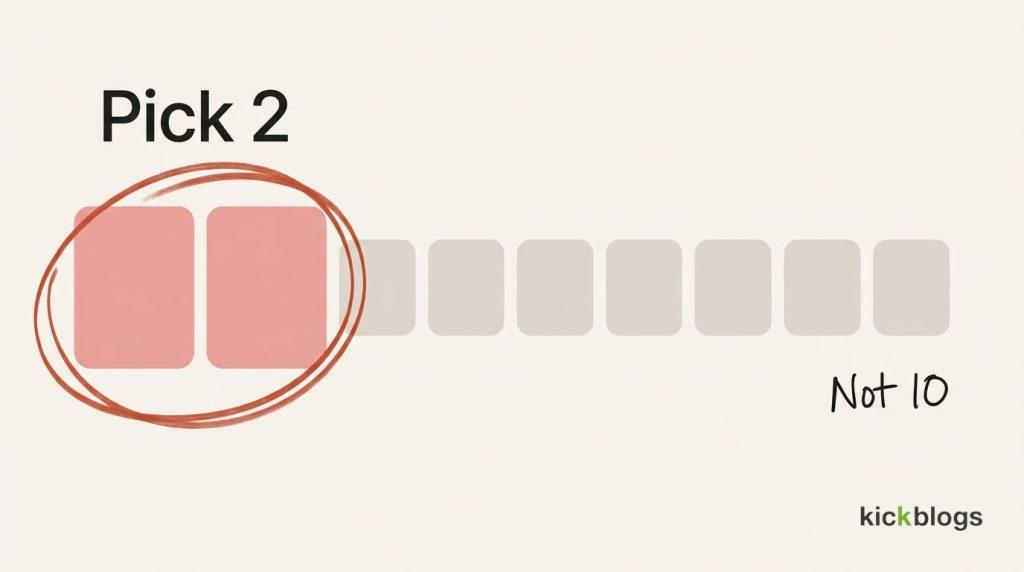
Ten identical marketing tactic tiles with only two circled, showing the pick-two-not-ten idea.
They don’t. These tactics differ by more than tenfold in what they return per dollar, and by more than a year in how long they take to pay anything at all. Two of them got quietly repriced in the last eighteen months, and most guides still have not caught up.
So: the same set of tactics, ranked. What each costs, what it returns, how long before it returns anything, and which two are actually worth your attention.
What Changed: Search Stopped Sending Clicks
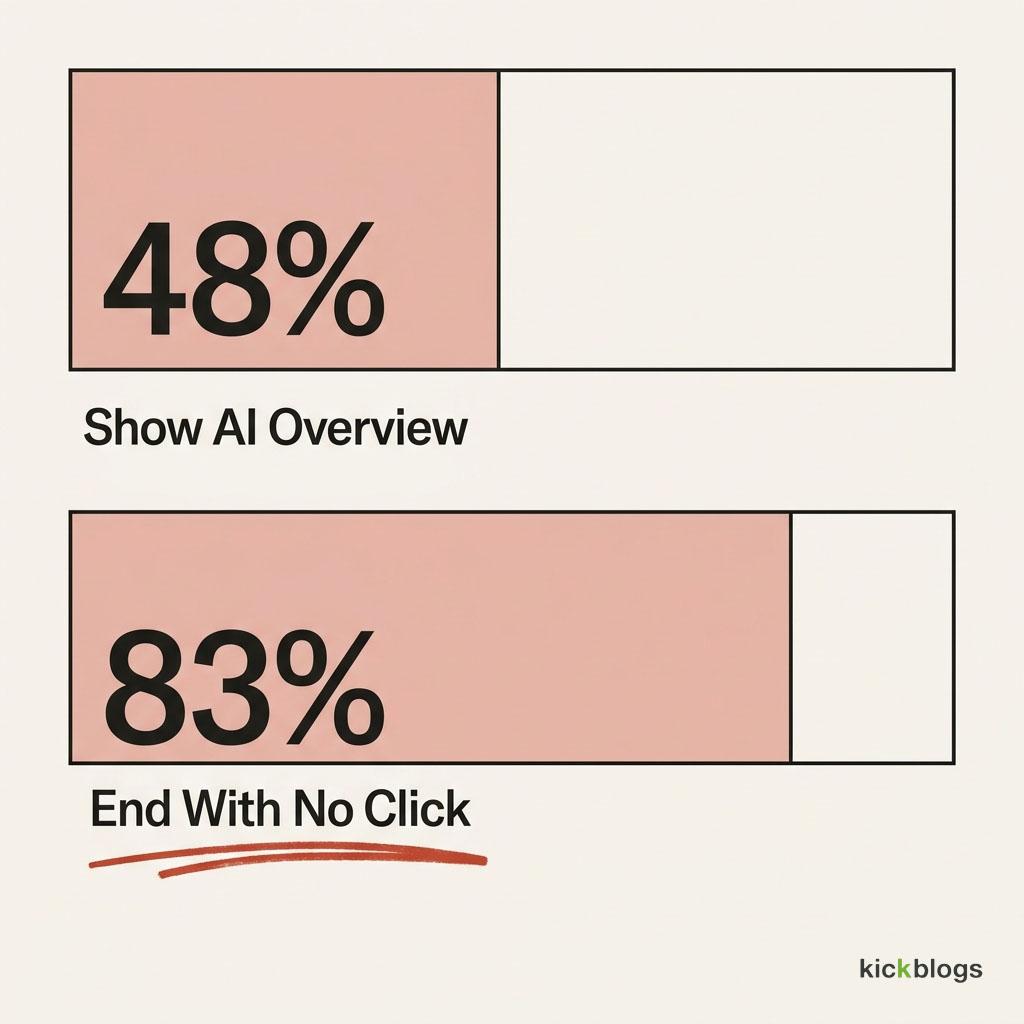
AI Overviews appear on 48% of queries, and 83% of those searches end without a click.
Start here, because it rewrites the maths on the two tactics every list puts first.
Content marketing and SEO have always rested on one assumption: rank well and the clicks follow. That assumption has broken. AI Overviews now appear on roughly 48% of tracked queries, up about 58% in a year. When one appears, around 83% of those searches end without anyone clicking through to a website at all.
Sit with that for a second. Half of searches now show an AI answer, and most of those get read and abandoned. Google is increasingly answering the question your article was written to answer.
None of which makes content and SEO worthless. It does mean the payback period stretched and the ceiling dropped, and any guide still listing “publish original content regularly” near the top without mentioning it is describing a world that has moved on.
What still earns clicks is content an AI summary cannot stand in for: your own data, your own customers, your own opinion, and anything a reader has to act on rather than simply know.
Undifferentiated explainer content is precisely what gets summarised and skipped.
The Payback Table
The honest version of the list. Costs assume a small business doing the work in-house or with light contracting.
| Tactic | Typical return | Time to first payback | Precondition |
|---|---|---|---|
| Email marketing | ~$36-42 per $1 | Weeks | You have customers to email |
| Paid ads | ~$2 per $1 | Days | A page that already converts |
| SEO and content | Compounding, no fixed rate | 6-12 months | Patience, and something AI cannot summarise |
| Social media | Highly variable | 3-12 months | One platform, done properly |
| Thought leadership | Indirect | 12 months plus | An audience that already exists |
| Analytics | Nothing directly | Immediate | It makes the others measurable |
Two things jump out of that table. Email isn’t marginally better than the alternatives; it is an order of magnitude better. And analytics returns nothing on its own, which is exactly why it belongs on the list but never at the top of it.
Start Here: The Two That Pay Back Fastest
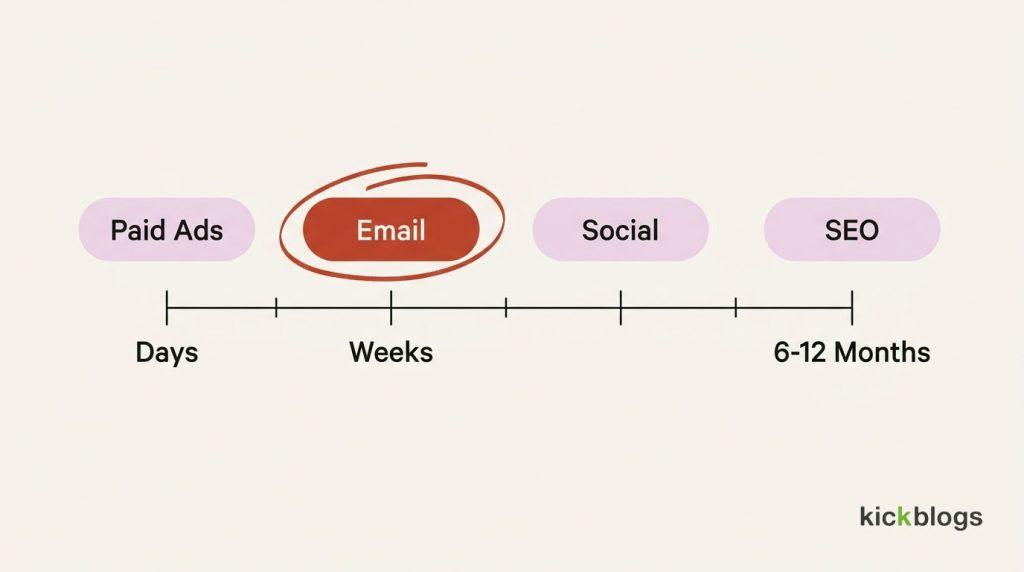
Marketing tactics placed on a payback timeline from days for paid ads to 6-12 months for SEO.
Email, first and by a distance
Email returns somewhere around thirty-six to forty-two dollars for every dollar spent. Paid search runs about two. Social ads sit under three. The gap is not subtle, and yet email remains the tactic small businesses most reliably neglect, mostly because it feels duller than the alternatives.
The catch is that precondition: you need people to email. Email cannot go and find you customers. It can only make the ones you already have worth considerably more. Which is why it is the first thing to build the moment anyone at all is buying, and useless as an opening move if nobody is.
Start smaller than you think you should. One welcome sequence that fires after someone buys, and one genuinely useful monthly email. That is the entire build. Elaborate segmentation can wait until there is something worth segmenting.
Paid ads, but only after your page converts
Paid advertising works, with one precondition the original list never mentions: your page has to convert already.
If a hundred organic visitors produce zero enquiries, buying a thousand more produces zero enquiries and an invoice. Paid traffic amplifies whatever your page already does with visitors. Amplifying zero gets you zero, slightly faster.
So sequence it. Get a page converting on traffic you didn’t pay for, work out what a customer is genuinely worth to you, then go buy more of them. At that point ads stop being a gamble and turn into arithmetic: a customer worth a hundred dollars who costs thirty to acquire is one you buy as many of as you can find.
Worth It, Slowly: Content and SEO After AI Overviews
Content and SEO still belong on the list. They belong lower than most guides put them, and they need a different brief than they did three years ago.
The timeline was always slow: only about 5.7% of new pages reach Google’s top ten within a year of going up. AI Overviews have shrunk the prize at the end of that wait as well, since ranking now competes with an answer sitting above the results.
What survives is content that resists summarising. Original data from your own business. An opinion someone could reasonably disagree with. Specific numbers, prices, comparisons. Anything where the reader has to do something, not just learn something. If three sentences in an answer box can replace your article, they will.
Plant this because you want it to exist in twelve months, not because it will earn anything this quarter.
It’s why we created this related guide on how to create search-relevant content for your site, with honest answers.
Mostly Not Worth It Yet
The original treats these as equal partners to the rest. For most small businesses, they aren’t, and saying so plainly is more useful than being polite.
Thought leadership. Most articles suggest activities, including speaking at industry events, running webinars and producing podcasts. All real tactics. Nearly all of them require an audience you do not yet have. Thought leadership converts attention you already own; it very rarely creates it from nothing. Come back to this when people are listening.
Social profiles on every platform. Opening accounts everywhere and posting regularly isn’t a strategy; it’s a chore that scales badly. Yes, open all the accounts when you first start, but choose one to focus. One platform where your buyers actually gather, posted to properly, beats five neglected profiles. Many articles tell you to populate them all “regularly” without once asking whether your customers are there.
Analytics as an activity. Tracking matters, and it is not a marketing tactic. It’s the instrument panel. Watching traffic climb while enquiries stay flat is not progress; it’s just a nicer-looking chart. Pick the two numbers that map to money, usually conversion rate and cost per enquiry, and ignore most of the dashboard.
Pick Two, Not Ten
Here is the bit a listicle will never tell you, because ten items look more generous than two.
A small business running ten tactics is running ten tactics badly. Marketing rewards depth, not coverage. Two things done properly for six months beat ten done occasionally, and it isn’t close.
If you already have customers, the two are email plus one acquisition channel, whichever one your buyers genuinely use. If you have no customers yet, it is one acquisition channel and nothing else, because email has no one to reach and thought leadership has no one listening.
That’s the whole decision. Everything else on the list is something you add later, once the first two run without your constant attention and you can take on a third without dropping them.
And if the honest position is that you have no audience at all and no appetite for the twelve-month version, that’s worth naming: buying a business that already has traffic and customers is the one route that skips this timeline rather than working within it. It costs money rather than time, which is the trade.
Our guide on how to grow your online business covers where that fits, and the KickBlogs marketplace lists what is currently for sale.
Frequently Asked Questions
What is the most effective digital marketing tactic?
Email, by a wide margin, returns roughly thirty-six to forty-two dollars per dollar spent against about two for paid search. The qualifier is that it only works once you have customers to email. If you have none yet, your most effective tactic is whichever single channel actually reaches your buyers.
Is SEO still worth it in 2026?
Yes, with lower expectations and a different brief. AI Overviews now appear on roughly half of tracked queries, and most of those searches end without a click, so ranking no longer guarantees traffic. SEO still compounds over years, and content AI cannot cleanly summarise, meaning original data, real opinions and specifics still earn clicks.
How many marketing tactics should a small business run?
Two, done properly. Marketing rewards depth over coverage, and a business running ten tactics is running all of them badly. Add a third only once the first two work without your constant attention.
How long before digital marketing starts working?
Depends entirely on the tactic. Email pays back in weeks, paid ads within days once your page converts, SEO in six to twelve months if at all. Most people quit because they brought SEO patience to a channel that should have paid faster, or expected email speed from content.
Do I need to be on every social media platform?
No, and trying is a reliable way to waste a year. One platform where your buyers genuinely spend time, posted to properly, beats five neglected profiles. Choose based on where your customers already are, not on which platform is being talked about.
Get High-Level Support
Buying a Local Business: What Turnkey Really Means
“Turnkey” is the word a seller reaches for when they’d rather you stopped asking questions….

Get More Clicks on Your Google Ads Without Paying More
Most articles on this topic list five or six ways to get more clicks. The…

Starting a Business After The Kids Leave Home
The Victorian Government’s Better Health Channel describes it in language most people would not dare…

You Need To Know This – Before Starting An Online Business
Almost every guide to starting an online business opens the same way. Here are the…
How To Successfully Run A Facebook Page
You should have a Facebook Page. That part of the standard advice is correct, and…
Buy an Established Website vs Build From Scratch: An Honest Comparison
A Shopify subscription costs about forty dollars a month. An established online business costs somewhere…
How to Create Search-Relevant Content in 2026
Search-relevant content answers the exact question someone typed, in the shape they expected the answer…
How To Choose The Best Social Media Platforms For Your Website?
Most advice on this hands you a list of things to consider. Your audience. Your…