

Most articles on this topic list five or six ways to get more clicks. The lists aren’t wrong. They’re flat, as though each listed item moved the number by the same amount, and they skip past the one sentence that explains how any of this works.
That sentence was this: “with the same amount in ad spend”.
It reads like a caveat, but it’s the mechanism. More clicks without more money means each click costs less, and what your clicks cost isn’t something you control. It’s decided in an auction, by a formula, and only one part of that formula is under your control.
What Sets the Price of a Click
Every time someone searches, Google runs an auction and calculates an Ad Rank for each competing ad. Ad Rank decides whether you appear, where you appear, and what you pay when someone clicks.
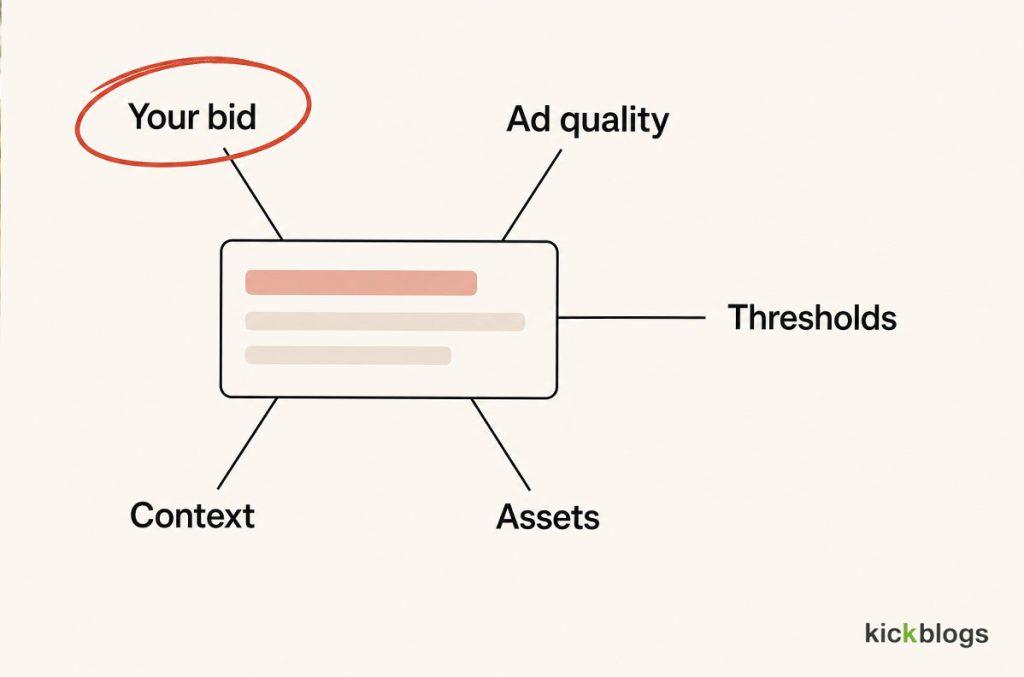
Google’s own guidance is explicit that Ad Rank uses your bid, auction-time ad quality, the Ad Rank thresholds, the context of the search, and the expected impact of your assets.
Your bid is one input out of five.
The part you can move fastest is ad quality, and the diagnostic Google gives you for its Quality Score: a 1 to 10 rating on each keyword, built from three components. Expected click-through rate. Ad relevance. Landing page experience.
Google does not publish how it weights them, but advertiser-side analyses consistently land near 39% expected click-through rate, 39% landing page experience, and 22% ad relevance.
The same caveat applies to what the score is worth in money, and it’s worth stating plainly because the figures get quoted as though Google published them. Google does not. Advertiser-side analyses put a keyword scoring 1 to 3 at up to 400% more per click than the same keyword scoring 5, and a keyword scoring 10 at up to a 50% discount. Treat those as the shape of the effect rather than a rate card.
Even discounted heavily, nothing else in the account has that range. Rewrite a headline, and you gain a fraction of a percentage on the click-through rate. Lift a keyword from a 3 to an 8, and you can halve what you pay for the same position.
Your bid is one input out of five. The spread between a poor Quality Score and a good one is wider than anything you will get from rewriting headlines.
One thing to hold on to, because it trips people up. Quality Score is a diagnostic, not the thing itself. Google calculates ad quality fresh at auction time, on the actual query, the actual device, the actual moment.
The 1 to 10 number sitting in your account is a historical summary you steer by. It’s not what the auction reads.
The Levers, Ranked by What They Move
All the tips appear below, in order of how much they shift your cost per click. Four new additions are there, and two of those outrank everything else on the list.
| What it moves | Typical effect | Effort | |
|---|---|---|---|
| Assets (sitelinks, callouts, snippets) | Expected CTR, and Ad Rank directly | 10% to 20% CTR lift, more on branded | An afternoon, once |
| Negative keywords | Wasted spend, and average Quality Score | Varies, often the largest single saving | An hour a fortnight |
| Landing page experience | Around 39% of Quality Score | Large, and slow to move | Weeks |
| Match types and structure | Which auctions you enter at all | Large, and easy to get wrong | Ongoing |
| Ad copy | Ad relevance, around 22% of Quality Score | Modest, and now partly automated | Ongoing |
| Bid and budget | Volume, not efficiency | None, on its own | Minutes |
Assets are the Fastest Lift
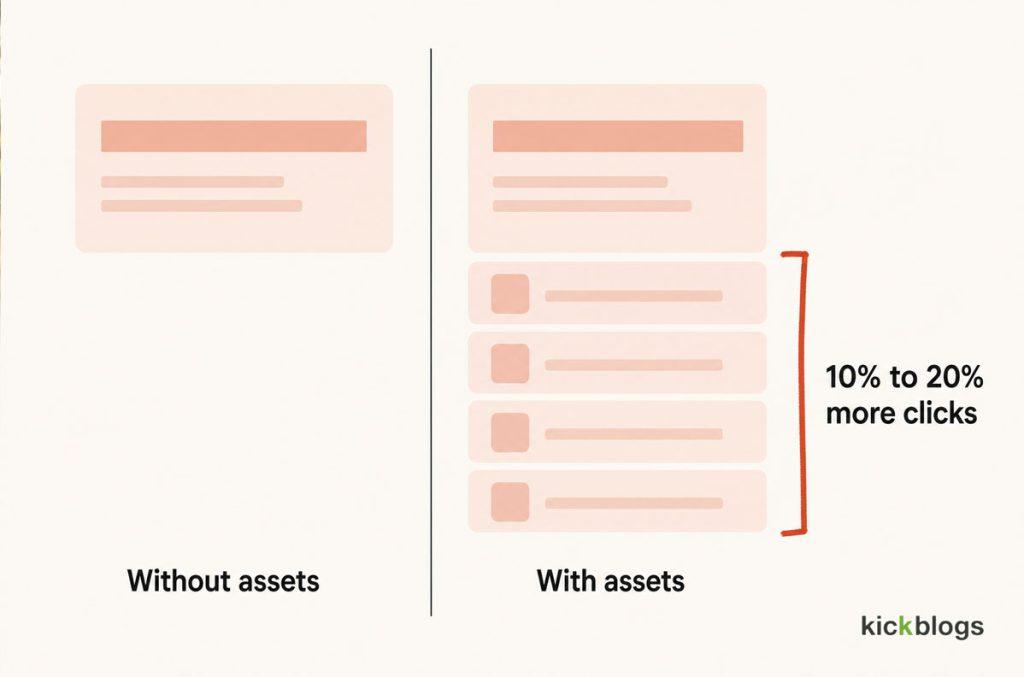
Assets used to be called extensions. They are the extra lines under your ad: sitelinks, callouts, structured snippets, images, prices, locations.
They matter for two separate reasons, and the second is why this goes first. Adding sitelinks alone lifts click-through rate by roughly 10% to 20% on non-branded searches and 20% to 50% on branded ones.
Layering callouts, structured snippets and images on top typically pushes the combined lift past 20%. Google’s own figure for adding six sitelinks is a 3.5% increase in conversions at a similar cost per conversion.
The second reason is that expected asset impact is a named input into Ad Rank. So assets do not only raise your click-through rate. They raise your Ad Rank at the same bid.
Two effects, one afternoon of work, and an account without them is leaving both on the table.
If you do one thing from this article, do this one.
Negative Keywords Are the Clicks You Should Not Be Buying
The most misleading piece of account maintenance advice is to remove keywords that are not generating clicks. That’s close to the least useful change available, because a keyword getting no clicks is costing you nothing.
The expensive problem runs the other way. Keywords that do get clicks from people who were never going to buy. Someone searching “free”, “jobs”, “how to make”, “DIY”, or the name of a competitor you don’t stock.
Every one of those clicks bills you at full price and then drags your conversion rate down, which drags your Smart Bidding performance down with it.
The fix is the search terms report, which shows the queries that actually triggered your ads rather than the keywords you bid on.
Read it fortnightly. Add anything irrelevant as a negative keyword. In a small account, this is routinely the largest single saving available, and it costs nothing but the hour.
Your Landing Page Sets the Price Before Anyone Clicks
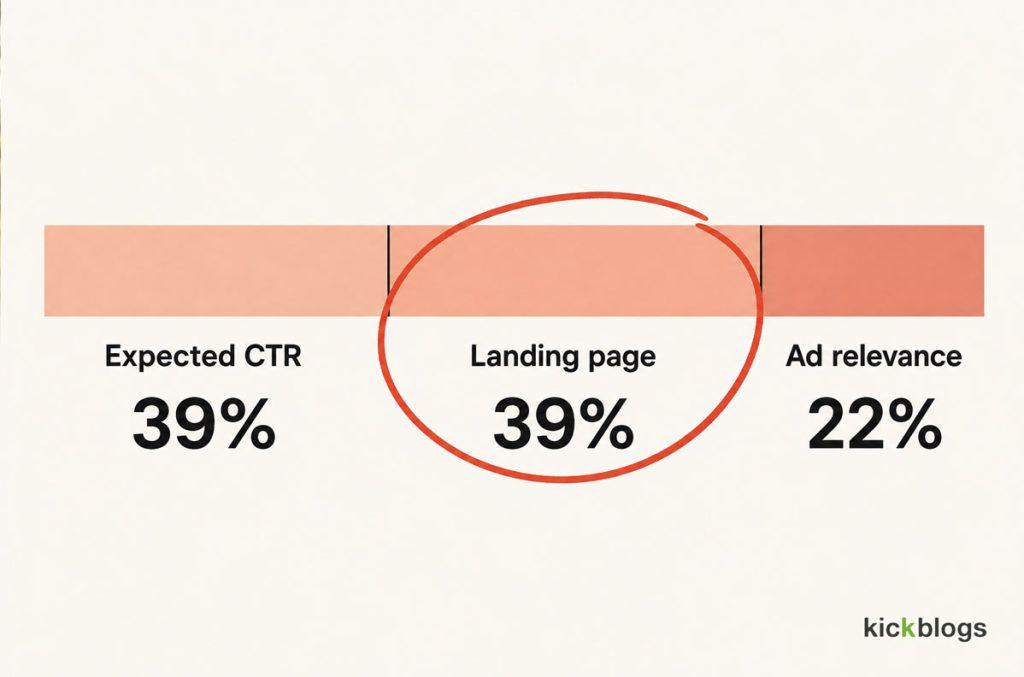
This is a counter-intuitive one, because the landing page experience carries roughly the same weight in Quality Score as expected click-through rate. Not post-click weight.
Quality Score weight, which makes it part of what you’re charged for the click itself. A slow, vague or mismatched page raises the price of every click you buy, before the visitor has formed an opinion about anything.
What Google assesses is whether the page delivers on the ad’s promise: relevant content, a clear next step, fast loading, and no gap between the headline someone clicked and what they landed on.
The most common failure is not an ugly page. It’s an ad for one specific product pointing at the general homepage.
Ad Relevance Is Now Partly the Algorithm’s Job
Responsive search ads are what you write now, and they work differently. You supply headlines and descriptions, and Google assembles combinations per query.
That changes the instruction. “Write compelling ad copy” still holds, but the useful version is to supply genuinely different assets rather than fifteen rewordings of one sentence, and to leave the system room to learn.
Forcing every keyword into its own tightly themed ad group, standard practice for years, now starves it of the data it needs to work out which combinations perform.
Ad relevance is also the smallest of the three components at around 22%. Do it well. Do not do it first.
Keywords, Match Types, and the Advice That Expired
Most articles say to choose keywords with high search volume and low competition.
That idea comes from SEO, and it doesn’t transfer to ads. In an auction, low competition usually means low commercial intent, because the reason nobody else is bidding is that nobody makes money there. Traffic that costs little and buys nothing is not a discovery. It is the trap.
Match types have moved too. Broad match now operates alongside Smart Bidding and conversion signals rather than as a standalone setting, and Google’s relevance improvements have lifted broad match performance by around 10% for advertisers using Smart Bidding.
Phrase match has correspondingly fallen out of favour. None of this appears in the original, which does not mention match types at all.
Bidding and Budget Move Volume, Not Efficiency
The old advice was to determine what you’re willing to pay per click and set your budget accordingly. That’s manual CPC, and most accounts are no longer run that way.
Now with Smart Bidding, you set a target cost per acquisition or a target return on ad spend, and Google sets the per-click price to hit it. Your budget then controls how much volume you buy, not how efficiently you buy it.
Raising the budget on an inefficient account buys more of the same problem.
What This Costs in Australia
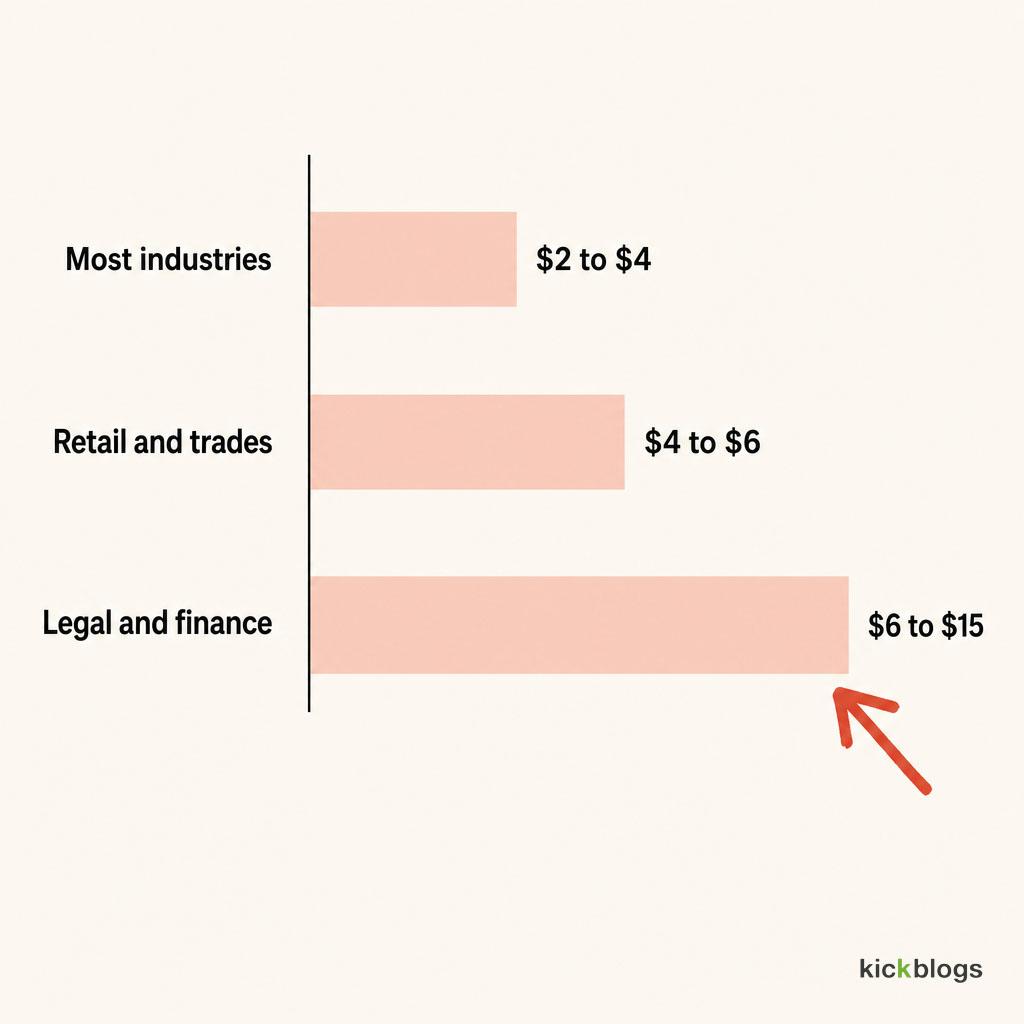
Most guides on this topic quote US figures, which is how Australian advertisers end up budgeting against the wrong numbers.
Australian search costs run roughly $2 to $4 AUD per click across most industries, against $3.50 to $4.20 in the same industries the US benchmarks cover.
That’s a premium of roughly 30% to 55% over US pricing, in a smaller market. Legal, finance and insurance sit well above it at $6 to $15 or more.
The all-industry paid search averages worth measuring yourself against are about a 6.64% click-through rate and a $5.42 cost per click.
Most Australian small businesses spend somewhere between $1,500 and $3,000 a month. GST applies to your ad spend on top of that, which is the line people forget when they set the monthly figure.
Put those together, and the case for the Quality Score work stops being abstract. On $2,000 a month, a 20% reduction in cost per click buys around $400 of additional clicks without an extra dollar of budget.
Same money, a fifth more traffic. Which is what the original promised and never explained how to get.
More Clicks Is Not the Goal
The sections above answer the question in the title. It’s worth finishing by admitting the question is not quite the right one.
A click-through rate is a ratio, and you can lift it by writing an ad that appeals to people who were never going to buy. Broad emotional headlines do this reliably.
So does anything hinting at a lower price than you charge. You will get your clicks, you will pay for every one of them, and your cost per acquisition will get worse while the metric on your dashboard improves.
The number that matters is what a customer costs against what a customer is worth. We have set out that arithmetic, including why a $60 product on a 35% margin cannot survive paid traffic, in what to know before starting an online business.
So read this article as being about a narrower thing than its title suggests. Not more clicks. The same money buying better-qualified clicks, because you fixed the score that was inflating their price.
If the clicks you already have are not converting, none of this helps, and the honest answer is that the problem sits upstream of the ad.
Where paid search ranks against everything else you could spend the money on is a separate question, and we have ranked the options by payback in our breakdown of digital marketing tactics.
The Traffic You Do Not Pay Per Click For
One closing note: it’s what this marketplace sells, so weigh it accordingly.
Every improvement in this article lowers the price of renting attention. The rent does not stop. Turn the ads off, and the traffic stops that afternoon, which is the structural weakness of paid search and the reason nobody builds a business on it alone.
An established site with rankings already in place is the other arrangement. Slower to acquire, and it keeps working when you stop paying. Most durable operations end up running both, using ads for the queries that convert now and organic for the ones that compound. If you want that comparison done properly, including where buying goes wrong, it is in our guide to buying an established website versus building from scratch.
If you need help setting up an ad campaign, we have some marketing services available, or you can get advice in our members section.
Frequently Asked Questions
What is a good click-through rate on Google Ads?
All-industry paid search averages sit near 6.64%, so that is the bar to measure against, though it varies widely by industry and by whether the search was branded. Branded searches run far higher and are not comparable. More useful than the raw number is the trend on your own account after you add assets and negative keywords.
How do I lower my Google Ads cost per click?
Raise your Quality Score. Advertiser-side analyses put a keyword scoring 1 to 3 at up to 400% more per click than one scoring 5, and a 10 at up to a 50% discount. In practice that means adding assets, cutting wasted spend with negative keywords, and pointing ads at a specific relevant page rather than your homepage.
Does Quality Score still matter in 2026?
Yes, though not as the number itself. Google calculates ad quality fresh at auction time on the actual query, so the 1 to 10 figure in your account is a historical diagnostic rather than an input to the auction. It still tells you which keywords are overpriced and why, which is what you need it for.
How much do Google Ads cost in Australia?
Roughly $2 to $4 AUD per click across most industries, rising to $6 to $15 or more in legal, finance and insurance. That is a premium of about 30% to 55% over comparable US pricing. Most Australian small businesses spend between $1,500 and $3,000 a month, and GST applies to ad spend on top.
Should I still use single-keyword ad groups?
Generally no. Responsive search ads assemble headline and description combinations per query, and splitting every keyword into its own ad group leaves the system too little data to learn which combinations work. The practice made sense under expanded text ads, which were sunset in June 2022.
Are Google call ads still available?
No. Google removed the ability to create new call ads in February 2026, and existing call ads stop receiving impressions in February 2027. The replacement is a standard responsive search ad with call assets attached, which also carries the asset-driven Ad Rank benefit described above.
Get High-Level Support

Buying a Local Business: What Turnkey Really Means
“Turnkey” is the word a seller reaches for when they’d rather you stopped asking questions….

Starting a Business After The Kids Leave Home
The Victorian Government’s Better Health Channel describes it in language most people would not dare…

You Need To Know This – Before Starting An Online Business
Almost every guide to starting an online business opens the same way. Here are the…
How To Successfully Run A Facebook Page
You should have a Facebook Page. That part of the standard advice is correct, and…
Buy an Established Website vs Build From Scratch: An Honest Comparison
A Shopify subscription costs about forty dollars a month. An established online business costs somewhere…
How to Create Search-Relevant Content in 2026
Search-relevant content answers the exact question someone typed, in the shape they expected the answer…
How To Choose The Best Social Media Platforms For Your Website?
Most advice on this hands you a list of things to consider. Your audience. Your…

Digital Marketing Tactics Ranked by What They Pay Back
Most lists of digital marketing tactics online share the same flaw. They hand you ten…