
You should have a Facebook Page. That part of the standard advice is correct, and this article is not going to talk you out of it.
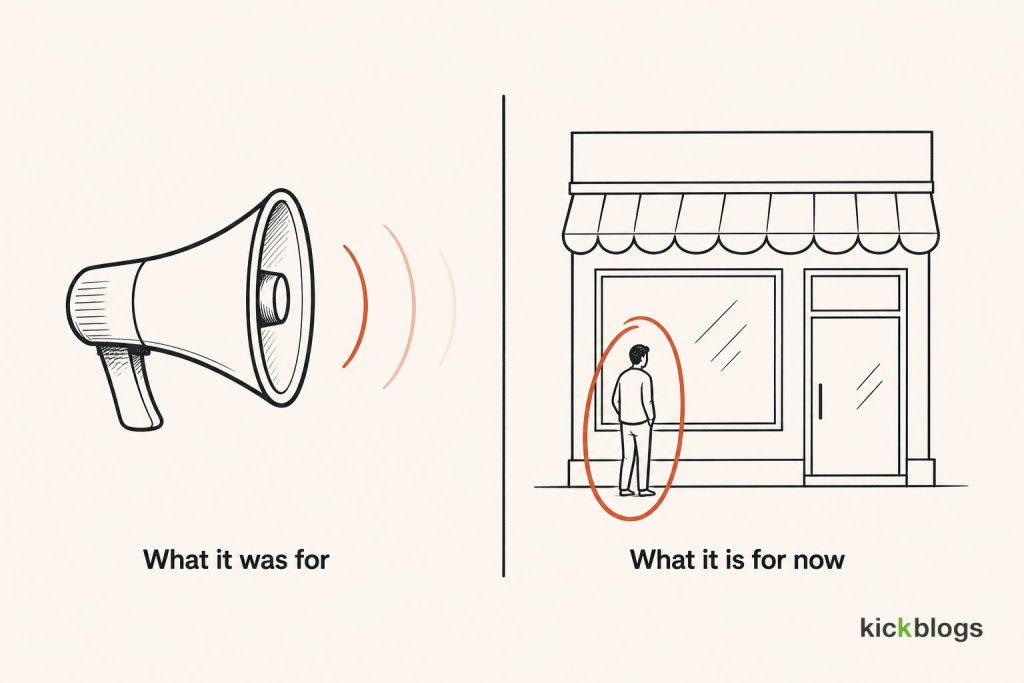
A Facebook Page has stopped being a megaphone and become a shopfront people check before buying.
What has changed is what the Page is for.
An earlier version of this article carried the assumption the whole topic used to rest on: when someone Likes your Page, they are more likely to see your posts in their News Feed. That was true when it was written. It is not true now, and almost every piece of advice built on top of it has quietly stopped working.
Facebook Page organic reach now averages somewhere between 1.65% and 2.2% of your followers. In 2014 it was over 15%.
So a Like buys you roughly a one in fifty chance of being seen. Posting twice a day and running campaigns to collect more Likes are both aimed at a distribution system that no longer distributes.
The Page is still worth having. It earns its keep three different ways than it used to, and running it well now takes about twenty minutes a week instead of an hour a day.
What a Like Actually Buys You Now
Numbers first, because the rest of this depends on them.
Facebook Page organic reach averaged 1.65% of followers in 2025. Other trackers put the usual range at 2% to 5%. One measurement puts 2025 at 2.2%, an 86% fall in twelve years. Metricool, analysing hundreds of thousands of accounts, found post reach down 41% year on year in 2024 alone.
Median engagement across industries is 0.15%. Rival IQ’s data runs from 0.02% to 0.23% for most sectors.
Those are two separate failures stacked on each other. Roughly one in sixty of your followers sees a given post, and roughly one in six hundred does anything about it.
Put that into the original’s own advice and the problem gets easier to see. The old version recommended posting one to two times per day. On a Page with 500 followers at 1.65% reach, each post is seen by about eight people. Follow the instruction for a year, and you have produced 730 posts for an average audience of eight.
Follow the old advice for a year and you have produced 730 posts for an average audience of eight people.
It is also still falling. Socialinsider’s quarterly tracking through the first half of 2026 shows every format down: status posts from 0.13% to 0.08%, images from 0.13% to 0.10%, Reels from 0.15% to 0.13%. Reels hold up best, which is the one useful thing that data says about format choice, and it is a small consolation.
None of this is a conspiracy against small business. Facebook has more content than it has feed; it sells the shortcut, and organic Page reach is the inventory it has spent a decade converting into advertising revenue. Reading it as a business model rather than a betrayal makes it much easier to plan around.
The Three Jobs a Facebook Page Still Does
Reach is gone. These three are not, and they are worth real money.
| What it does | What it needs from you | |
|---|---|---|
| Credibility check | 74% of consumers look you up before dealing with you | A complete profile, and something posted in the last 30 days |
| Inbox | Customers message businesses instead of ringing them | A reply within a day, and saved replies for the repeat questions |
| Ad container | You cannot run Facebook or Instagram ads without a Page | To exist, be complete, and not look abandoned |
It Is a Credibility Check
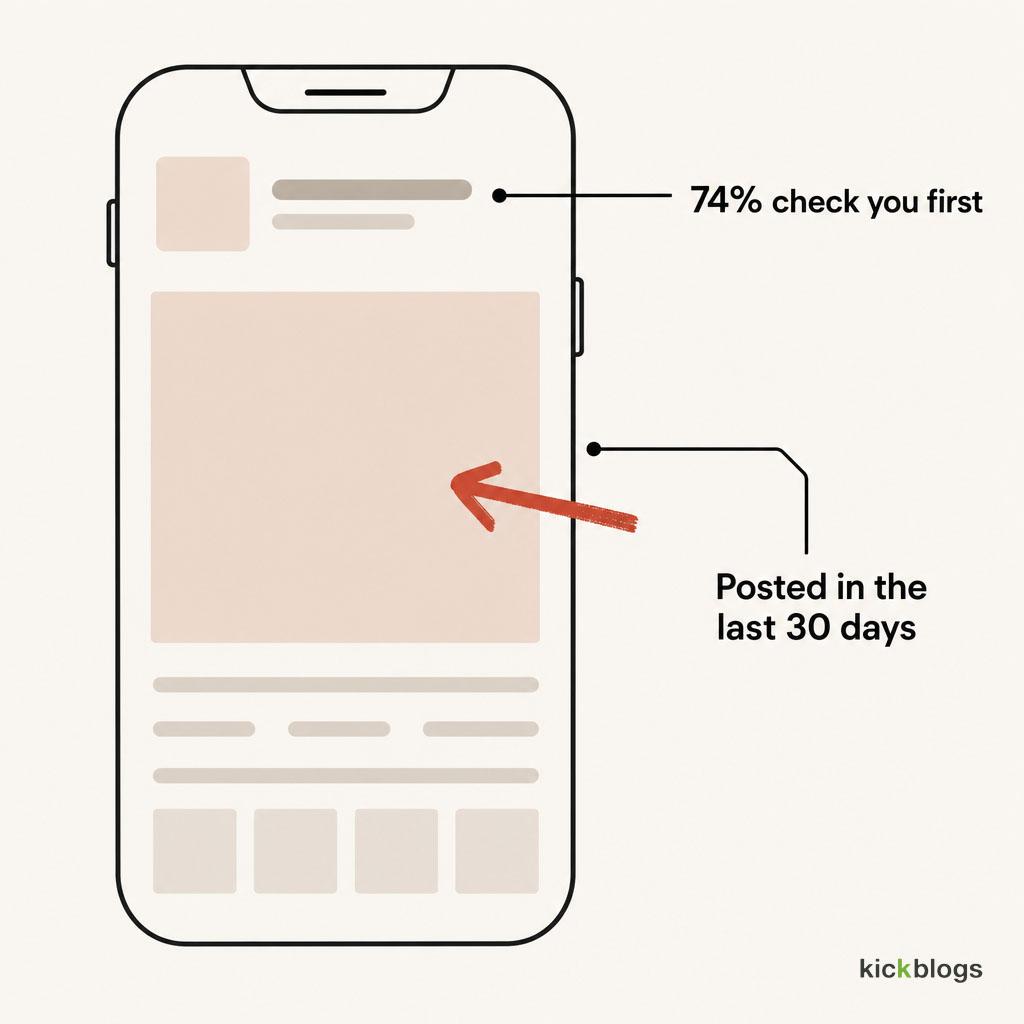
Most people check a business profile before dealing with it, and look for activity in the last 30 days.
The strongest argument for having a Page, and the original never reaches it.
74% of consumers check a brand’s social profiles before visiting in person, according to Sprout Social’s Consumer Trends Report. Among executives deciding whether to work with a company, 84% review its social presence first.
They are not reading your posts. They are checking that you exist, that the details match your website, and that somebody was here recently. The threshold people commonly apply is activity in the last 30 days. An empty or long-dormant Page reads as a business that has closed or stopped caring, and that impression forms before anyone has read a word of what you wrote.
Which flips the posting instruction completely. You do not need volume. You need recency. One post a fortnight clears the same bar that fourteen posts a fortnight clears, because nobody is counting.
It Is an Inbox
The Page is where people message you, and for a lot of businesses it has quietly replaced the phone as first contact.
The original treats replying to messages as a relationship-building nicety. It is closer to a service obligation, and it is the one thing on your Page with a direct line to revenue. Someone asking whether you have something in stock, or whether you service their suburb, is a customer with their wallet already out.
Set up saved replies for the three or four questions you answer constantly. Turn on away messages so the response-time badge does not embarrass you overnight. That is most of the work.
It Is the Container Your Ads Run From
You cannot run Facebook or Instagram advertising without a Page. The ads run from it, comments land on it, and people who click through to check you out will see it.
For a lot of businesses, this is the entire reason the Page has to exist, and it changes what “successful” means. A Page supporting an ad account does not need followers. It needs to be complete, current, and free of unanswered complaints sitting at the top of the feed.
The Twenty Minutes a Week Version
The original offered four overlapping lists of tips. This is the whole routine instead.
Once, when you set it up. Fill in every field: category, description, contact details, address or service area, hours, website link. Add a profile photo and a cover image that are not stretched. Turn on messaging, write saved replies for your three most common questions, and set an away message.
Time: two hours. Cost: nothing.
Fortnightly, about ten minutes. Post once. A real photo of work you have done, a job you have finished, a product that arrived, a change to your hours. Not a quote graphic. The post exists so the Page looks alive to the 74% who are checking, so it does not need to be clever, and it does not need to perform.
Weekly, about ten minutes. Clear the inbox. Reply to comments and reviews, including the bad ones, in public and briefly. Check nothing is sitting unanswered.
Quarterly, about half an hour. Open the Professional Dashboard, which is where Page Insights ended up, and check three things: whether messages are being answered inside a day, whether anything you posted did something, and whether your details are still accurate. Then close it.
That is the job. If you have been posting daily, you can stop, and the number that justifies stopping is 1.65%.
Where Organic Reach on Facebook Still Exists
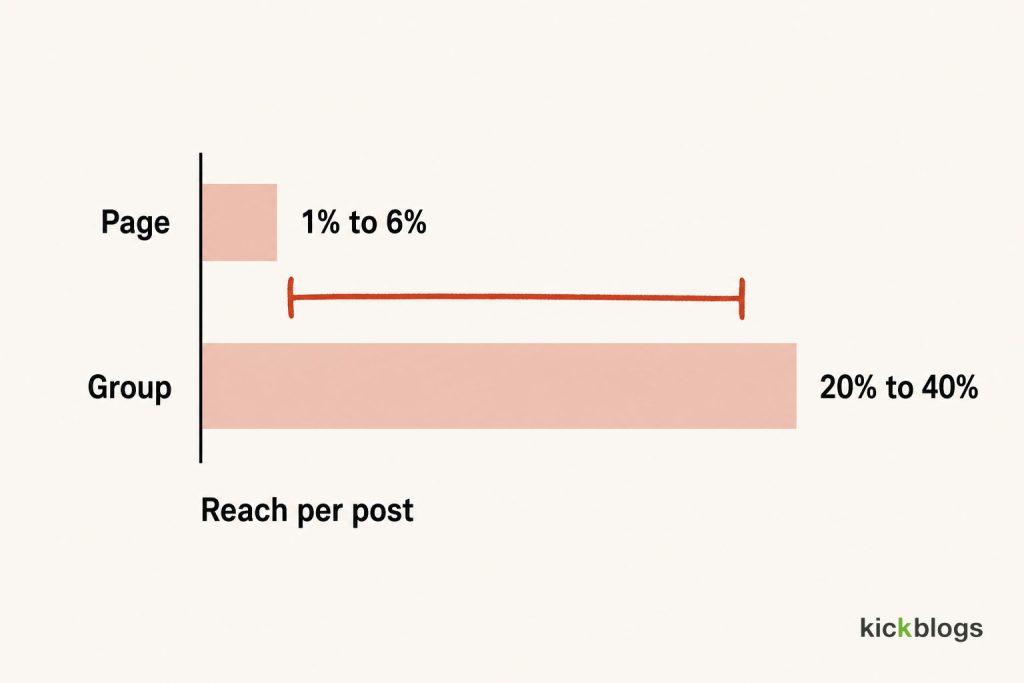
Facebook Groups reach 20 to 40 percent of members per post against 1 to 6 percent for Pages.
It is Groups, and the gap is not subtle.
Facebook Groups reach roughly 20% to 40% of members per post, against 1% to 6% for Pages. That is a ten to fifteen times multiplier. A 10,000-member Group typically reaches 2,000 to 4,000 people with a post. The same 10,000 people following a Page yields 200 to 600. Groups also generate 30% to 50% more engagement, and private Groups run about 40% higher than public ones.
The reason is straightforward. Facebook’s feed favours content from communities where people comment, and Groups have been the company’s stated direction for years while Pages have been the thing it monetises.
Two caveats before you go and start one. Running a Group is real ongoing work, closer to hosting than to publishing. And a Group with forty inactive members reaches forty inactive members: the multiplier applies to a community that exists, not to a container you created.
The better move for most small businesses is not to start a Group but to take part usefully in the ones already running in their area or trade. That is slower, it does not scale, and it works.
If you are still deciding whether Facebook is where your effort belongs at all, we have set that out separately in how to choose the best social media platform.
Get High-Level Support
How to Measure It Without Lying to Yourself
The original recommends tracking likes, comments, shares and how often people are talking about your Page. Under 0.15% median engagement, those numbers measure almost nothing, and they move for reasons unconnected to your business.
Track enquiries instead: the messages and calls that came through the Page. It is the only number with money attached to it. Alongside that, watch your response time, because whether you are answering inside a day is visible to customers and entirely within your control.
Reviews are the third one, and recency matters more than people expect. 88% of consumers are more likely to buy from a business with positive reviews, and 73% only trust reviews left in the last month. A five-star average from 2022 does less for you than a four-star average from last week.
The fourth is not a metric. Open your Page on a phone, logged out, the way a stranger would. If the newest thing on it is four months old, that is your problem, and it is a ten-minute fix.
Follower count is not on that list. Neither is reach. Both are inputs you do not control, measuring a channel that no longer delivers, and watching them is how people end up posting twice a day.
Where paid social sits against everything else you could spend the money on is a separate question, and we have ranked the options by payback in our breakdown of digital marketing tactics.
The Audience You Own Versus the One You Rent
One closing note, and it is what this marketplace sells, so weigh it accordingly.
The reach numbers in this article are the whole argument for owning your distribution. Nobody at Facebook did anything wrong. They changed the terms of a deal you never signed, and 15% became 1.65% over twelve years while everyone who had built on it watched.
An email list does not do that. Neither does a site that ranks. Both are slower to build, and neither can be taken off you by a product decision made in another country.
A Facebook Page is worth twenty minutes a week for the three jobs above. It is not worth building a business on, and the businesses hurt worst in the reach collapse were the ones that had. If you want the version where the traffic is already there and already yours, that is our guide to buying an established website versus building from scratch.
Learn More About Facebook in the Member’s Section
- How to create a Facebook account for your business
- How to create content for your Facebook account
- How to set up ads on Facebook
Frequently Asked Questions
How often should I post on my Facebook page?
Once a fortnight is enough for most small businesses. At 1.65% average organic reach, posting more does not buy proportionally more, and the job the post is doing is proving to visitors that the business is active. The threshold people commonly apply is activity within the last 30 days, so a fortnightly post clears it comfortably.
Is a Facebook page still worth it in 2026?
Yes, but not as a way to reach people. It is worth having because 74% of consumers check a brand’s social profiles before dealing with them, because customers message businesses there, and because you cannot run Facebook or Instagram ads without one. Judge it on those three jobs, not on reach.
Why has my Facebook page reach dropped so much?
Because Facebook has far more content than feed space and sells the shortcut. Average Page organic reach fell from over 15% in 2014 to roughly 1.65% to 2.2% now, and Metricool measured a further 41% year-on-year drop in 2024. It is not something wrong with your Page.
Should I pay to promote my Facebook page?
Not to collect Page likes, which buy you almost nothing now. Paying to reach people who might buy something is a different question and can work well. The distinction matters: promote an offer, a product or an event to a targeted audience, rather than promoting the Page itself.
Facebook page or Facebook group for my business?
A Page for the shopfront, a Group only if you will genuinely host it. Groups reach roughly 20% to 40% of members per post against 1% to 6% for Pages, but that multiplier only applies to a community that is active. Most small businesses get more from taking part in existing local Groups than from starting one.
Do Facebook likes still matter?
Very little. A Like once meant your posts appeared in that person’s feed, which is why the old advice chased them so hard. It now buys roughly a one in fifty chance of being seen. Incentivising likes is also against Facebook’s rules, which banned like-gating in 2014.
For more information, see our section devoted to social media, as part of our online business course.

You Need To Know This – Before Starting An Online Business
Almost every guide to starting an online business opens the same way. Here are the…
Buy an Established Website vs Build From Scratch: An Honest Comparison
A Shopify subscription costs about forty dollars a month. An established online business costs somewhere…
How to Create Search-Relevant Content in 2026
Search-relevant content answers the exact question someone typed, in the shape they expected the answer…
How To Choose The Best Social Media Platforms For Your Website?
Most advice on this hands you a list of things to consider. Your audience. Your…

Digital Marketing Tactics Ranked by What They Pay Back
Most lists of digital marketing tactics online share the same flaw. They hand you ten…

How to Grow Your Online Business: A Stage-by-Stage Guide
Search this question, and you get the same checklist every time. Build a website. Get…
How To Make Your Own Brand – Step-by-Step?
Making a brand is not the hard part. You can have a name, a logo,…
How to Get More Clicks For Your Google Ads Campaign
Another effective way to reach your target audience is by implementing Google Ads. However, many…