
The Victorian Government’s Better Health Channel describes it in language most people would not dare use.
When the last child leaves, it says, “the mother may feel that her most important job is finished”, and she “may feel worthless, disoriented and unsure of what meaning her future may hold”.
Psychologists quoted on the same page put the transition from mum to independent woman at between 18 months and two years.
Somewhere inside that window, most people who end up starting a business after their kids leave home go looking for what comes next.
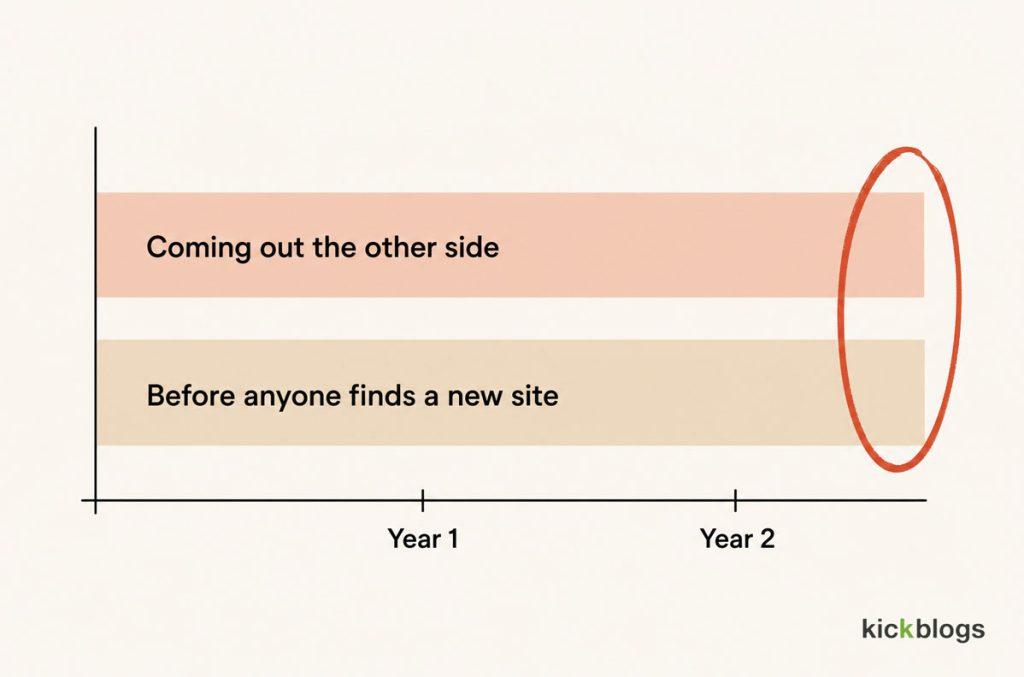
There’s a second clock running, and almost nobody mentions it. A brand new website takes roughly the same length of time before anybody finds it, and the odds are worse than you have been told.
Ahrefs studied 1.3 million keywords and found that only 1.74% of newly published pages reach Google’s top ten within a year of going live.
Those two clocks are the same length. The period when you most need evidence that something is working is exactly the period in which, starting from nothing, there’ll not be any.
That’s not an argument against starting. It’s an argument for knowing the shape of things before you start.
One disclosure before anything else. KickBlogs sells established websites, which is one of the three options set out below. The option we suggest you try first costs nothing and can be completed without our help. Read the rest with that in mind.
What follows: what you have, whether anybody needs it, how long it takes, and the three ways in.
What You Have Is Not Nothing

In December 2022, Google changed how it judges content, specifically to account for people who know things because they lived them. You almost certainly didn’t hear about it. Originally it was just E.A.T: Expertise, Authority and Trust.
There needed to be another category. Because what would you call this? You would call it “what I learned”, or “twenty years of homeschooling”, or “I looked after my Mum for six years”.
Google now grades its content on four qualities, now abbreviated E-E-A-T. The first E stands for experience, meaning first-hand or life experience with a subject, and Google puts it alongside formal expertise rather than underneath it.
Its own documentation asks: “Does your content clearly demonstrate first-hand expertise and a depth of knowledge (for example, expertise that comes from having actually used a product or service, or visiting a place)?”
Google’s examples are using a product and visiting a place, not getting a child through year twelve at your kitchen table. Your case is not named.
What the change establishes is that the distinction worrying you, between knowing something because you lived it and knowing it because you were certified in it, is one Google has deliberately stopped treating as decisive.
Google also says trust matters most of the four. Trust is the part you already have, and the one thing that cannot be written into existence in an afternoon.
What you knew in year one is already on the internet a thousand times over. What you knew in year eight is not.
Year one knowledge is published everywhere, mostly by people who read it somewhere else. Year eight knowledge, the part you only have because you got it wrong in year three and had to fix it, is published nowhere. That gap is your asset.
Three questions first before thinking about the business models:
- What do people already ask you? Not your topic. The actual question, in the words they use when they ask it.
- What did you know at year eight that you did not know at year one?
- How many people in Australia are at year one right now?
The third question has an answer.
Somebody Is at Year One of What You Just Finished
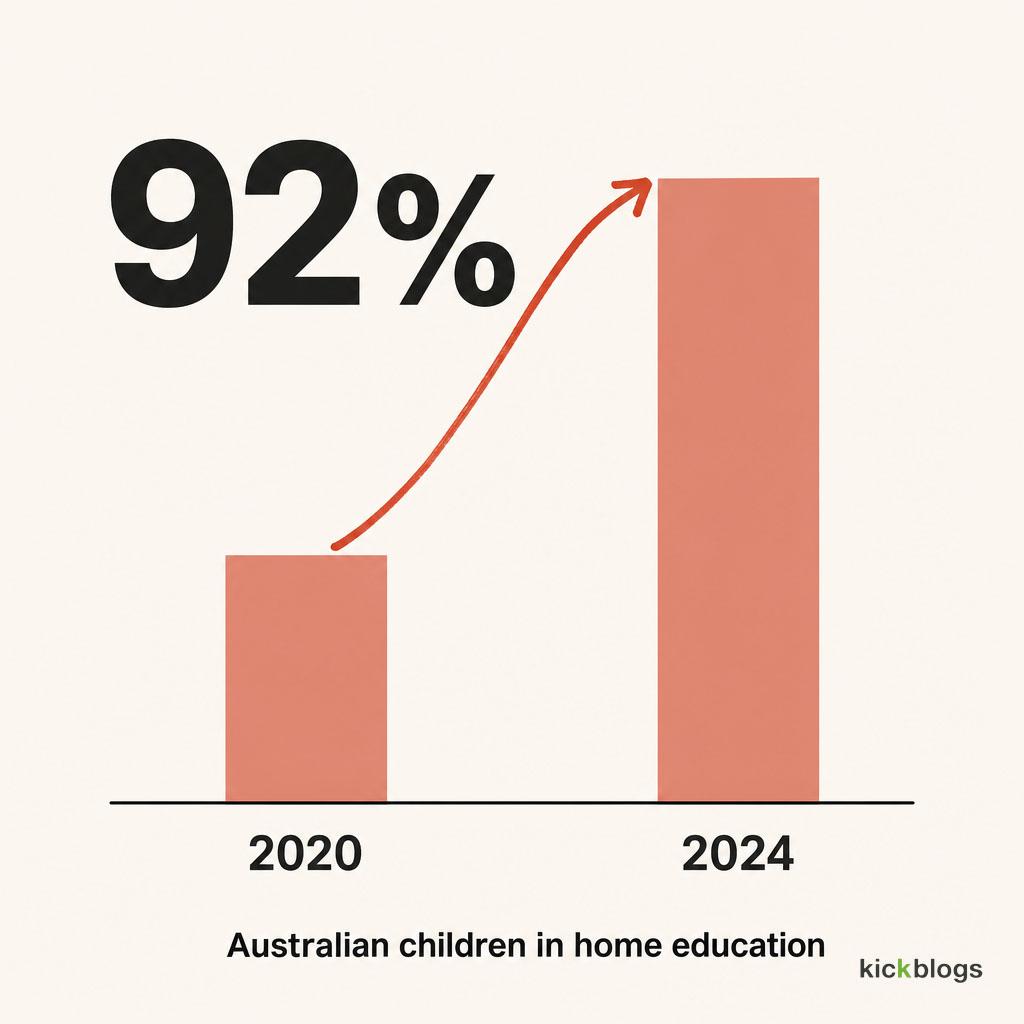
About 45,000 Australian children are registered for home education. That number rose 92% between 2020 and 2024. In New South Wales, registrations went from 5,907 in 2019 to 12,762 in 2024. Queensland had 11,800 registered students by August 2025, with primary registrations up 110% and secondary up 167% since 2021. Victoria has roughly 11,240 homeschoolers across 7,716 households.
Behind every one of those children is a parent. Most of them are at year one. Most of them are making decisions at eleven at night with nobody sensible to ask, just as you were fifteen years ago.
Homeschooling is the worked example rather than the only one. If your twenty years went into caring for a parent with dementia, or growing food somewhere that fights you, or raising a child whose diagnosis took four years to arrive, the arithmetic runs the same way.
Each of those has a large group of people going through the same thing. Each of those cohorts is currently being served by American content that does not know what a GP referral looks like here, or when the school year starts, or what any of it costs in dollars you use.
Which changes the question. Whether an audience exists was never in doubt. What matters is whether you can find the few hundred people who need your particular thing.
A few hundred is a believable number. It’s also enough. That’s a smaller order of magnitude than every article promising you an online empire implies, and it’s the one that matters.
Those few hundred people can be reached two ways. They search and find you, or they are already gathered somewhere, and you go to them. Those two routes run on very different clocks, and the difference between them is most of this decision.
The Part Every Other Article Leaves Out: How Long This Takes
The most widely shared homeschool blogging success story on the internet belongs to a woman named Monique. She started with six readers and a few cents a day from advertising. She now has 25,000 email subscribers, a membership, an ebook, and in her own words, “I now make what I made when I worked full-time.”
She started in 2010.
That date sits in the first sentence of the article about her and is never mentioned again. The distance between six readers and a full-time income was well over a decade, and she supplemented with graphic design work along the way, a detail that gets one clause.
None of which makes her outcome less real. It makes the timeline the thing being hidden.
Ahrefs studied 1.3 million random keywords and a million URLs, published in May 2025:
- The average page ranking first in Google is five years old, up from two years in 2017.
- 72.9% of pages in Google’s top ten are more than three years old, up from 59%.
- Only 1.74% of newly published pages reach the top ten within a year.
- The share of top ten results under a year old fell from 22% in 2017 to 13.7%.
The door has been closing, not opening.
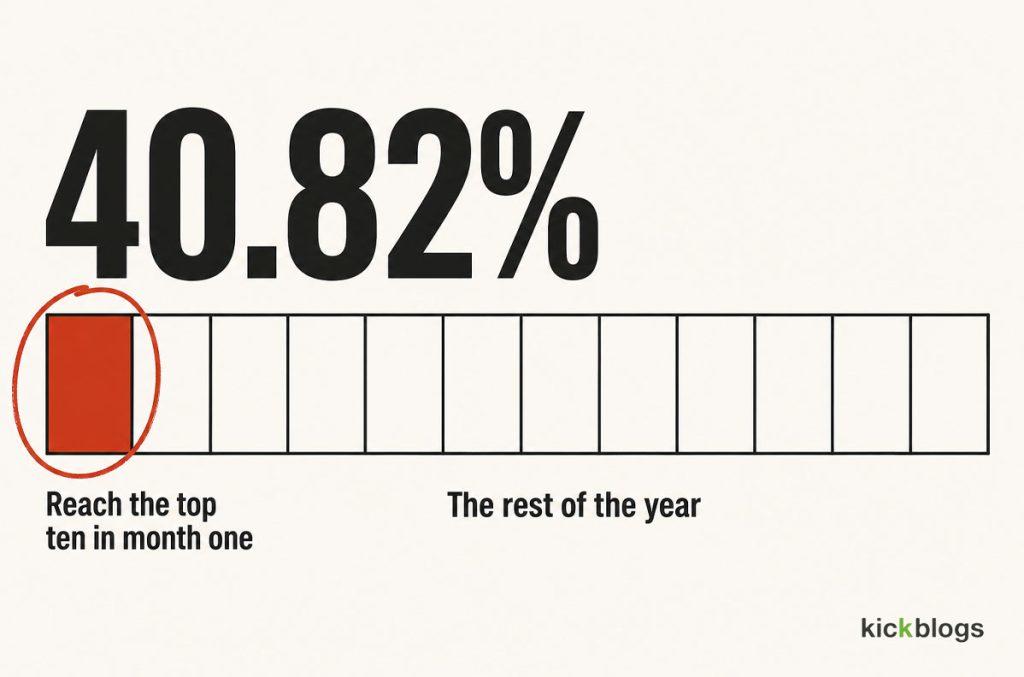
One figure cuts the other way. Of the pages that do reach the top ten, 40.82% get there within a month.
Ranking is not slow for everybody. It is fast on a domain that already has standing with Google, and close to impossible on one that does not. That single statistic is the whole argument for buying an established site instead of building one, and KickBlogs obviously benefits from you reading it that way. So there is the number. Go and check it.
Ahrefs’ own advice for a page still outside the top ten at six months is to go back and rework it. Six quiet months is the ordinary shape of the curve, not a verdict on you. You will read it as a verdict. Almost everybody does, and that is when most people stop.
Which brings the two clocks together. Eighteen months to two years to come out the other side of the transition. A year or more, at odds of 1.74%, before a new site is found by anyone at all.
The months when you most need proof that this is working are the months when, starting from scratch, there will not be any.
The question was never whether to start. It is which starting line you start from.
Three Ways In, and Only One of Them Costs Money

The first of the three costs nothing and can be tested this week.
| What to do | What it costs | Before anyone sees it | What you end up owning |
|---|---|---|---|
| Write in someone else’s audience | Nothing | Immediately | Nothing |
| Build from scratch | $20 to $50 a month | A year or more | Everything |
| Buy something with history | Real capital, once | Weeks | Everything |
Write inside somebody else’s audience. Go into a Facebook group you’re already in and answer one question properly. Not a post about yourself. A real answer, at length, to something somebody actually asked. Do it again a week later.
Then watch for the private messages. At this stage they’re the only signal worth anything. If four people ask you to write it down somewhere they can keep, you have your answer. If nobody does in eight weeks, you have that answer too, and it cost you nothing. Leanne, an Australian blogger we will come back to, wrote alone for months and her readership only moved when she found other women writing about the same stage of life.
The weakness is real. You own none of it; it compounds into nothing you could hand to anybody, and it is easy to spend three years there, mistaking activity for progress.
Build from scratch. Twenty to fifty dollars a month, complete control, nothing at risk except your time. If what you want is to understand how any of this actually works, this is the only one of the three that teaches you. It also starts at zero on the curve described above, and a blank site is paralysing when you do not yet know what to ask for. If you have already bought a domain you never used, you have met this problem before.
Buy something that already has history. What this buys is the part of the wait that has nothing to do with your expertise. New writing lands on a domain search already recognises, and the technical decisions were made before you arrived. This is what KickBlogs sells, and we wrote the full comparison out in buying an established website versus building from scratch.
The weaknesses matter as much. It takes real money at exactly the point you find spending hardest. The site may sit next to your subject rather than on it. And history does not buy you an audience that trusts you. You still have to write. The writing was always the entire job.
If you are reading this inside the first six months of the house going quiet, do the first one for eight weeks before you spend anything at all.
You Are Not Going to Break It
You asked one of your children for help. The conversation reached the word “hosting” inside two minutes, then “plugins”, and you came away with the distinct sense that you had wasted their afternoon. Nothing much has happened since.
The standard advice for people your age says your technical worry is not the real obstacle, that it is a mindset problem, and then hands you a platform decision two paragraphs later. Being told a fear is misplaced is not the same as being given an answer to it.
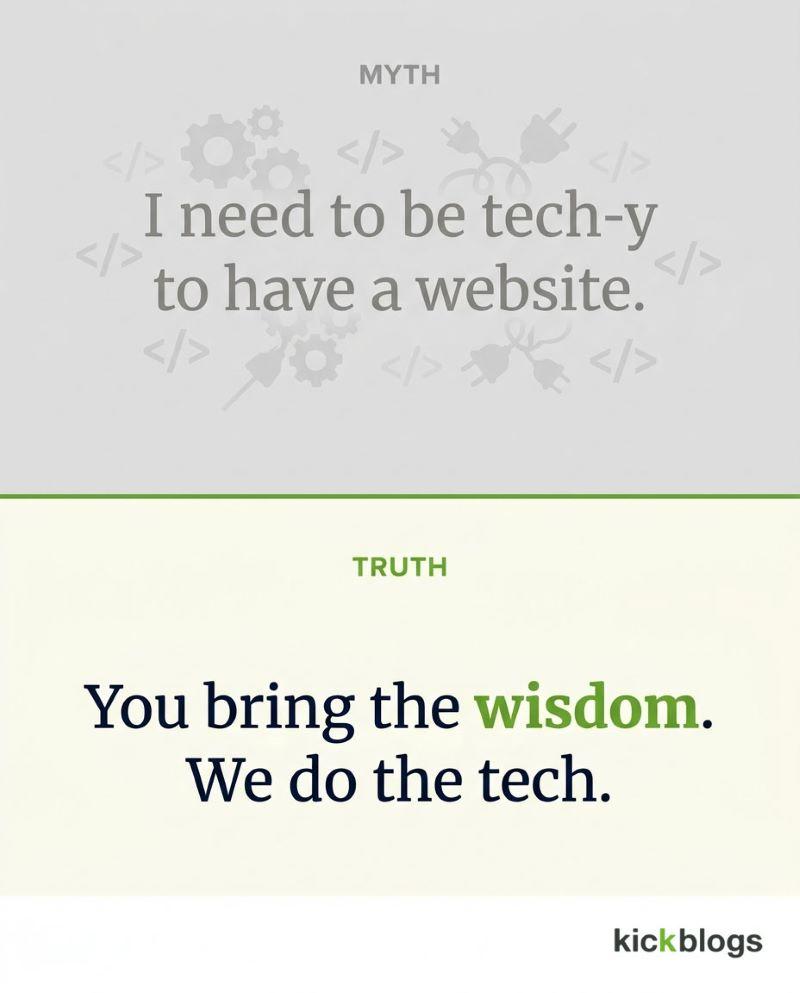
So draw the line somewhere useful. The writing is yours and cannot be handed to anybody, because what you know is the entire product. Hosting, updates, security and backups are plumbing. Plumbing is a line item on an invoice, not a skill you have to acquire at 54.
Publishing on a site that has been set up properly is closer to sending an email than to anything you would call computing.
Things do break. That part is true, and anybody telling you otherwise is selling something. But the question worth asking before you commit to anything is who picks up the phone when it does, and whether they are in this country.
You can get an answer to that before you spend a dollar, and it will tell you more than learning what a plugin is.
What It Costs to Try, and What It Costs Not To
You have probably absorbed the figure that 80% of blogs fail within eighteen months. It has no study behind it, only aggregator pages quoting each other, the oldest version a line in a 2009 newspaper article claiming most blogs were derelict.
The real numbers are less dramatic and more useful. The ABS tracks Australian business survival. Roughly three-quarters of new businesses reach their first anniversary, and about half are still trading at four years. For non-employing businesses, which is what a one-person website is, around 47% make four years, and for sole traders it is closer to 43%. So slightly under half. That is the honest figure, and it belongs here.
Content websites change hands at roughly 30 to 45 times their monthly profit. Nobody is suggesting you should sell anything. The useful part is that what you build holds a value whether or not you stay interested in it, which is precisely what a Facebook page does not. It is a thing rather than an activity.
Which brings us back to Leanne. She started Cresting the Hill in November 2014, in her early fifties, after her children left. Her own description of that period: “lost and unsure of what middle age had to offer”, and then, “Who was I now?”
Ten years on: 1,115 posts, 32,500 comments, almost three million views. That is roughly two posts a week for a decade, which is the part worth sitting with.
She has never published an income figure. What she names as the payoff is that it “gave me a community of people who bring me joy and inspiration and commonality.”
The income was never the thing worth having. The income is what lets the thing worth having continue.
The eighteen months pass either way. That is the only genuinely urgent fact on this page, and it is not urgent in a way that requires you to do anything today.
If you get to the end of those eight weeks and the messages came, and you want to talk through which of the three routes suits what you know, have a chat with us. Nothing about that conversation obliges you to buy anything.
Frequently Asked Questions
Am I too old to start a business at 55?
No. Nearly half of Australian small business owners are aged 50 or over, and the most common age for an Australian small business owner is exactly 50. Age is not the constraint here. The constraint is that you have one window of real momentum after the house goes quiet, and it is worth not spending all of it waiting for a brand new website to be noticed.
How long before a new website gets any visitors?
Longer than you have been told. Ahrefs found that only 1.74% of newly published pages reach Google’s top ten within a year, and that 72.9% of top ten pages are more than three years old. Their own advice is to reassess a page that is still invisible at six months. Six quiet months is normal rather than a verdict, though it will not feel that way.
Do I need qualifications to write about what I know?
No. Google added Experience to its content quality framework in December 2022, defined as first-hand or life experience with a subject, and placed it alongside formal expertise rather than beneath it. Google also states that of the four qualities it grades, trust matters most. Twenty years of doing something produces trust that no qualification and no amount of research can manufacture.
What if I am not good with computers?
Separate the writing from the plumbing. The writing is the job, and it cannot be delegated because what you know is the product. Hosting, updates, security and backups are somebody else’s line item. The question to ask before committing to anything is who answers the phone when something breaks, and whether they are in Australia.
Should I build a website myself or buy one that already exists?
They answer different questions. Building costs twenty to fifty dollars a month and starts at zero on a curve where 72.9% of top ten pages are over three years old. Buying skips that wait and costs real capital up front. KickBlogs sells the second one, so read our full comparison of the two with that in mind.
How much can I earn from this?
If income is the reason to start, this is the wrong thing to start. The most cited success story in this niche began in 2010 with six readers, took well over a decade to reach a full-time income, and involved other paid work throughout. Income here is a lagging indicator of something else entirely, which is whether what you know genuinely helps the people at year one.
Get High-Level Support

Get More Clicks on Your Google Ads Without Paying More
Most articles on this topic list five or six ways to get more clicks. The…

You Need To Know This – Before Starting An Online Business
Almost every guide to starting an online business opens the same way. Here are the…
How To Successfully Run A Facebook Page
You should have a Facebook Page. That part of the standard advice is correct, and…
Buy an Established Website vs Build From Scratch: An Honest Comparison
A Shopify subscription costs about forty dollars a month. An established online business costs somewhere…
How to Create Search-Relevant Content in 2026
Search-relevant content answers the exact question someone typed, in the shape they expected the answer…

How To Choose The Best Social Media Platforms For Your Website?
Most advice on this hands you a list of things to consider. Your audience. Your…

Digital Marketing Tactics Ranked by What They Pay Back
Most lists of digital marketing tactics online share the same flaw. They hand you ten…

How to Grow Your Online Business: A Stage-by-Stage Guide
Search this question, and you get the same checklist every time. Build a website. Get…