
Nearly every guide about using Instagram for business opens with the same instruction. Build a following. Optimise the profile, pick the hashtags, post consistently, and the followers will come.
Then once you get the followers, you find out only half a per cent of them react to anything you ever post. It’s very disheartening.
That figure is very close to Socialinsider’s 0.45%, measured across Instagram in the second quarter of 2026, and it’s still falling.
If your following was what distributed your content, this channel would be finished for any business under a few thousand followers.
It’s not finished. The advice is just describing a mechanism that stopped working a few years ago.
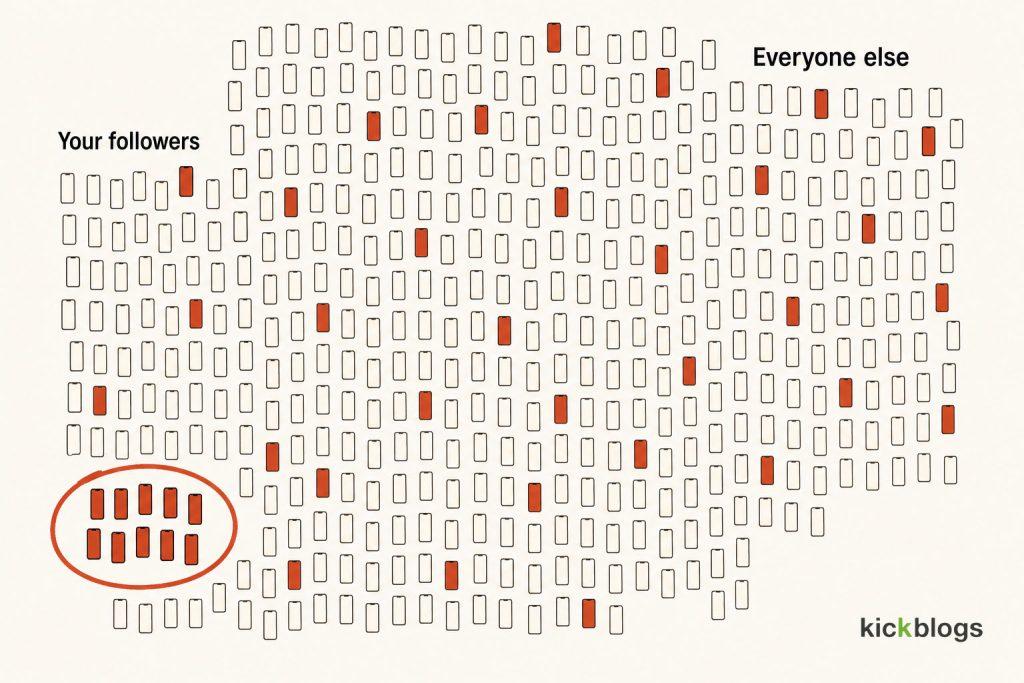
Instagram now decides who sees a post mostly on interest rather than on who follows you.
That single change has moved almost everything:
- which format is worth making
- where the words in your caption go
- what a good week looks like
- how you tell whether any of it’s working.
” How do I get more followers” is now the wrong question to ask. The right question is where the reach comes from, and what it costs to get it.
What A Follower Actually Buys You Now
With Instagram’s overall engagement rate at 0.45% and organic reach falling 12% year on year, followers don’t matter. Every format listed below is drifting in the same direction:
| Q1 2026 | Q2 2026 | |
|---|---|---|
| Carousels | 0.52% | 0.50% |
| Reels | 0.50% | 0.48% |
| Single images | 0.35% | 0.33% |
If you do the arithmetic on a real account with 500 followers and you post something that performs at the platform average, about two of them do anything at all.
Not buy anything. Anything: a like, a comment, a save.
Two.
Sprinklr tells you a strong monthly growth rate is 10% to 20%. Taggbox, also on page one of the same search, says 2% to 6% and calls anything above 6% exceptional.
Those answers differ by a factor of five, and a reader has no way to adjudicate between them.
So if you have been posting into what feels like an empty room and quietly concluding you’re doing it wrong, that conclusion is probably incorrect.
The room is empty for nearly everybody. Two people per post is not your failure; it’s the platform average.
None of this means Instagram doesn’t work for a small business. It works. In this environment, the following is simply not the mechanism that makes it work.
Instagram Stopped Being A Following And Became A Search Engine
Instagram runs two distribution systems at once, and neither works the same way.
Your feed posts go mostly to people who already follow you. That’s the surface where the 0.45% lives.
Reels go mostly to people who don’t follow you, and are distributed based on what Instagram thinks they’re interested in rather than to whom they have chosen to see.
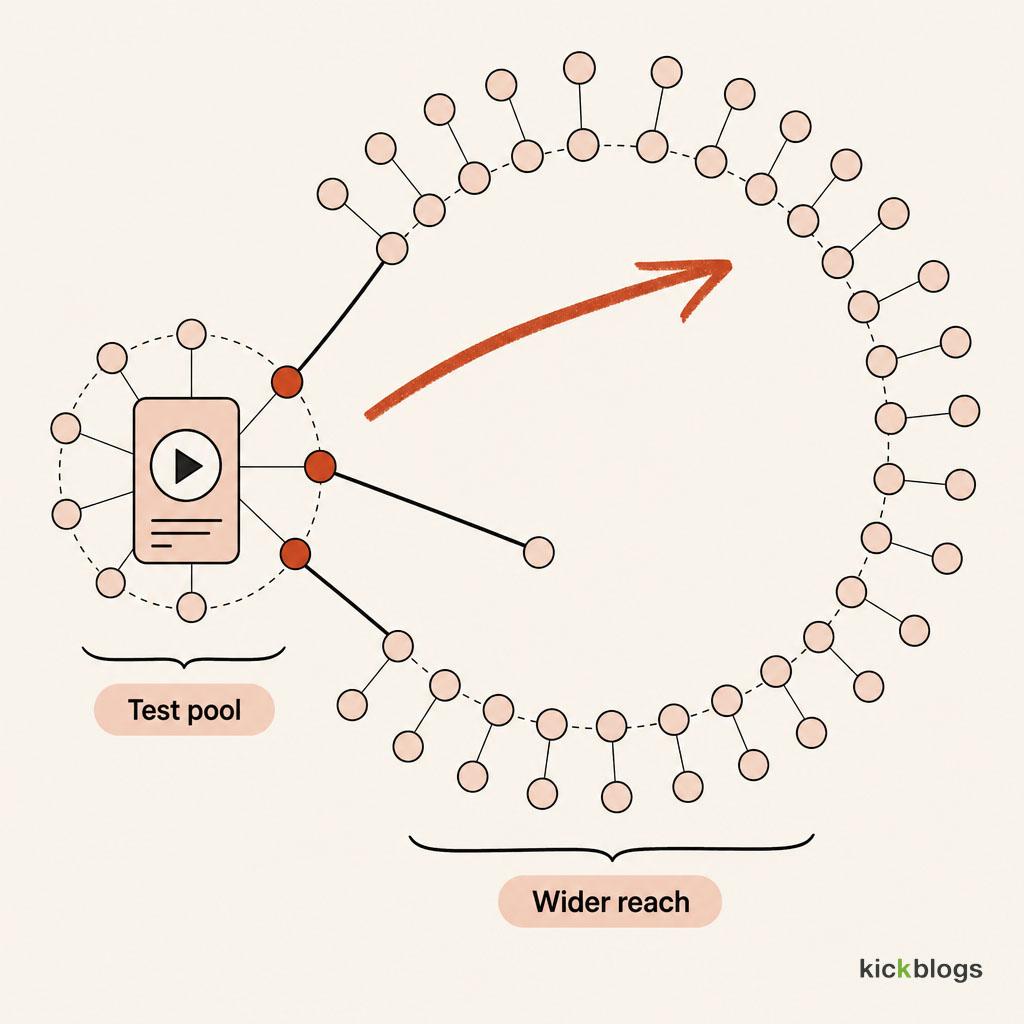
The second one is where the reach is, and it works by audition.
When you publish a Reel, Instagram does not show it to your followers and stop. It pushes it to a small test pool, watches what that pool does, and expands distribution only if the signals come back positive.
The signals it weighs heavily are watch time, saves, shares and the DM’s. A like barely even registers.
This is why the account-size logic that applies elsewhere does not apply here.
Every Reel starts in roughly the same place, a small test pool, and earns its way out on how people react.
A 200-follower account and a 200,000-follower account are auditioning under far more similar conditions than you would expect.
Your follower count is not your reach. It has not been for a while.
One caution, because it changes how you should read everything else written on this subject.
You will see it stated everywhere that 55% of Reel views come from non-followers. The figure appears in dozens of 2026 marketing articles, and it traces back to nothing.
No study, no sample size, no date, usually a vague gesture toward a benchmark report that does not contain it.
The direction it points to is right. The precision is invented.
Treat that as the standard for the rest of the advice you find here. A number without a named source and a date is decoration, and this topic is full of it.
Your own account insights beat all of it, because they’re about you.
Starting Small Is Not The Disadvantage You Think It Is
Engagement splits sharply by account size, and it splits in the direction most people don’t expect.
| The number of followers | Typical engagement rate |
|---|---|
| 1,000 to 10,000 followers | 4% to 6% |
| 10,000 to 100,000 | 2% to 5% |
| 100,000 to 500,000 | 1.5% to 3% |
| Over 1,000,000 | 0.5% to 2% |
Influencer Marketing Hub’s 2026 figures put the smallest accounts at 5.2% against 2.3% for the largest. Socialinsider, Buffer and Metricool each found the same pattern separately this year: small accounts out-engage large ones on every platform.
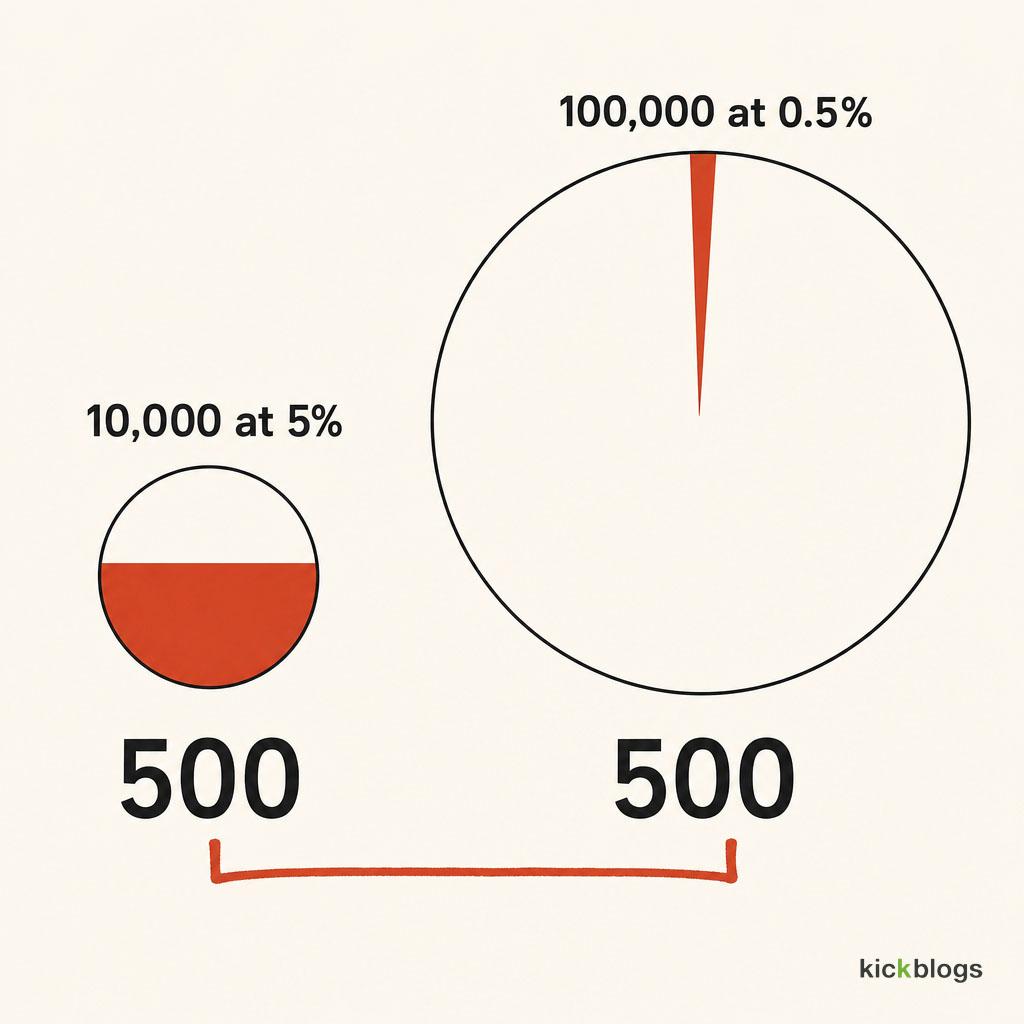
The consequence is worth calculating on paper. An account with 10,000 followers engaging at 5% produces 500 interactions. An account with 100,000 followers engaging at 0.5% produces the same 500 interactions. One tenth of the audience, the same result.
The mechanism is the audition again. Instagram reads a responsive audience as evidence that content is worth showing to strangers, and a small audience that watches and saves is a stronger signal than a large one that scrolls past. That signal is what decides how far past your followers a Reel travels.
Now, the honest part, because this particular fact gets oversold.
It’s an advantage in rate, not in volume. 5% of 200 followers is ten people, and ten people is ten people.
What the rate buys you is that your ceiling is not set by your follower count. A small account with content people engage with and save can reach tens of thousands through the Reels audition system.
A large account with content people scroll past cannot compete, and they will pay more for the privilege of finding that out.
You’re not behind. You’re starting, which is a different thing, and the platform is considerably less interested in the difference than you are.
Put The Words Where Instagram Can Read Them
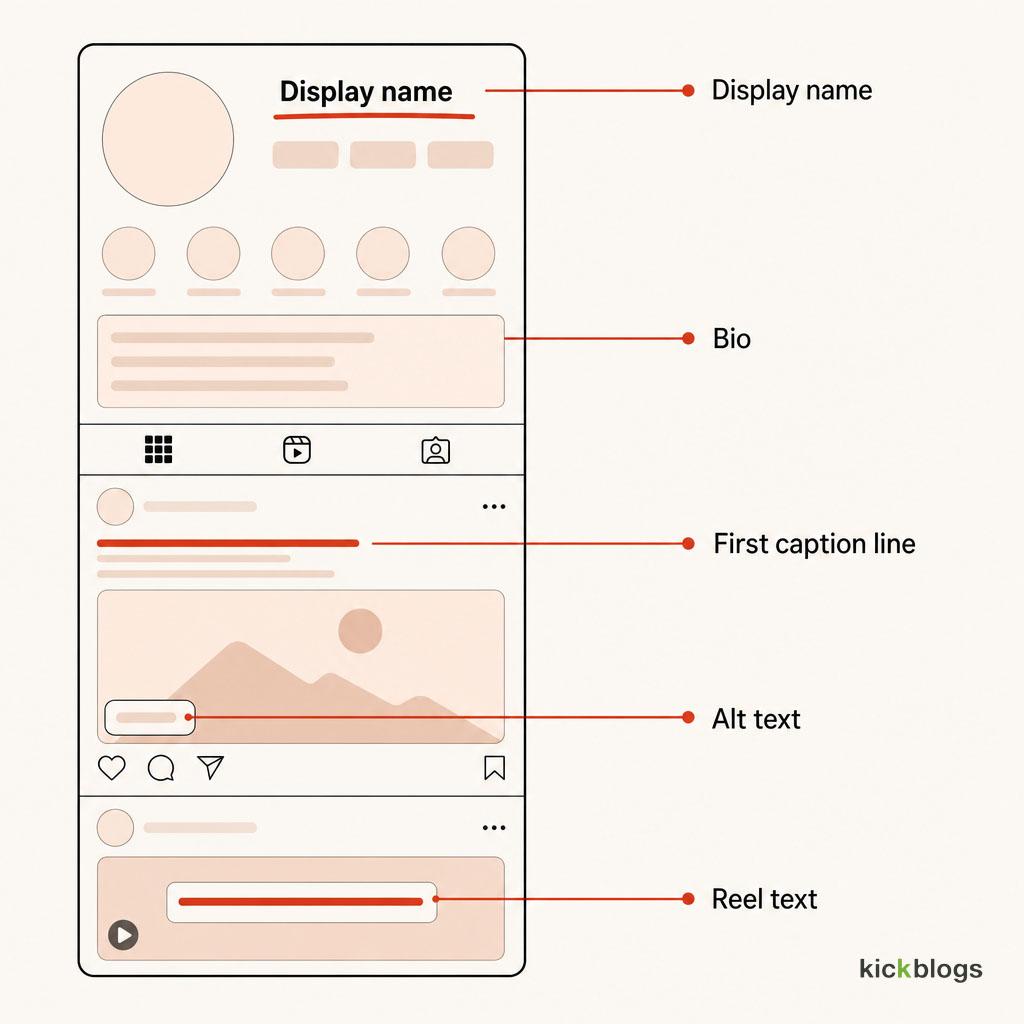
Hashtags no longer drive discovery, and the change is recent enough that most published advice has not caught up.
Posts that lean on them see 32% fewer views and 34% fewer interactions, according to Metricool’s 2026 analysis. In 2023 and 2024, hashtags were the mechanism. Now they are filing labels.
What replaced them is search. Instagram indexes the words you write and matches them against what people type into the search bar, and there’re five places where they read it.
- Your display name. Not the handle, the name field underneath it. This is the most valuable text on your profile, and most businesses waste it by repeating the business name. Put the category in it, or the town, or both.
- Your bio. Say what you do in the words a customer would use, not the words your industry uses.
- The first line of your caption. The algorithm weighs the start of a caption more heavily than the end. Your keyword belongs in the first sentence, not buried in the third paragraph above a wall of tags.
- Alt text. Almost nobody fills this in. It is a direct, uncontested signal, and it takes ten seconds.
- On-screen text in Reels. Instagram reads the words burned into your video, so text on screen is doing two jobs at once.
Run one keyword through all five.
A candle maker in Bendigo does not put “Aurora Studio” in the name field and hope. The name field reads “Aurora Studio | Soy Candles Bendigo”.
The bio says hand-poured soy candles, made in central Victoria. The caption opens with “hand-poured soy candles” rather than “so excited to share”.
The alt text describes the candle. The Reel carries “Soy Candles, Bendigo” on screen in the first two seconds.
One keyword, five placements. That’s the difference between findable and invisible.
On hashtags, since you will still want some: three to ten targeted, relevant tags beat thirty generic ones. They still help Instagram categorise you. They’re simply not the front door any more.
Time: about an hour, once. Cost: nothing.
The Three Hours A Week Can Be Sufficient
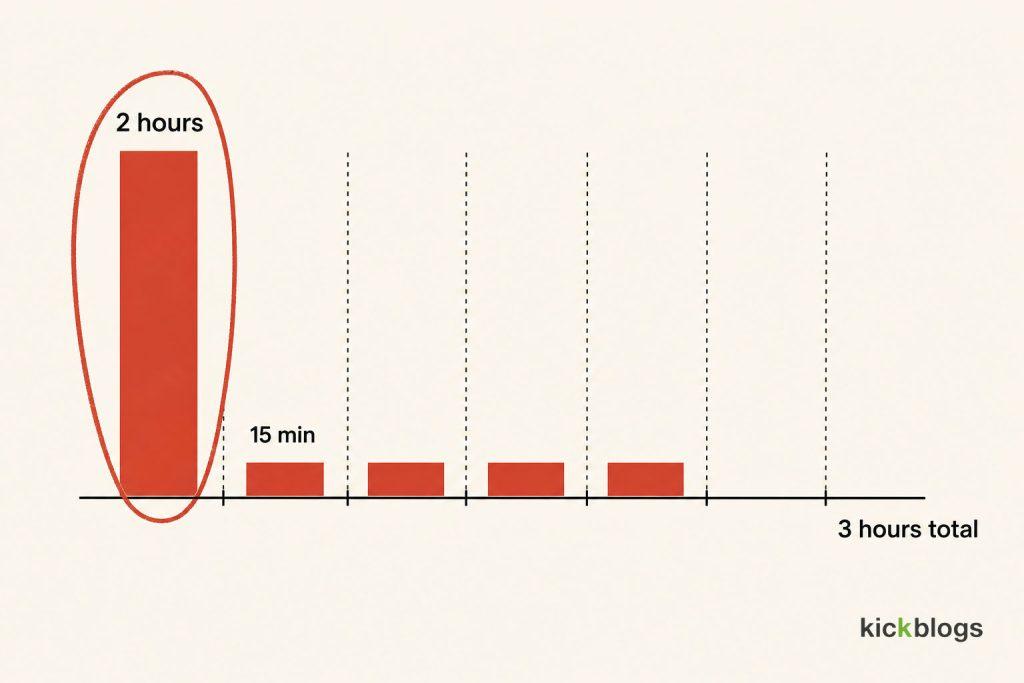
Firstly, the numbers count. Running an Instagram account for business properly takes about three to five hours a week. Producing three Reels and two carousels a week.
If you have evenings and weekends rather than a marketing department, three hours is the achievable figure, and it only works when batched.
One session of two hours, once a week. Shoot everything at once. Three to five pieces of content filmed back to back, captions written at the same time.
Filming one Reel takes about forty minutes once you include setting up and deciding what to say. Filming four takes ninety, because the setting up and the deciding happen once instead of four times.
Fifteen minutes a day, four or five days a week. Replies to comments and direct messages, and nothing else. This is not optional garnish. Sends and saves are what the audition measures, and conversations produce both.
On frequency, three to five posts a week feels like the right number. A consistent schedule produces roughly five times the engagement of sporadic high-volume posting.
Posting twice a day for three weeks and then nothing for a month is worse than posting three times a week forever, because the second pattern trains both the algorithm and your audience, whereas the first trains neither.
On posting times, ignore what you read online. They’re all in American time zones, and your own account insights already know when your audience is awake.
Organic is not free. It is billed in hours instead of dollars, and the invoice arrives every week.
One more thing, because this word comes up constantly around this subject. This isn’t passive, and it doesn’t become passive.
There’s no month in which the content keeps arriving without you. If that’s what you’re after, you’re going to have to hire a team.
Time: about 3 hours a week, every week. Cost: nothing but the hours.
If You Sell To One Town, The Rules Change
If your customers all live within thirty minutes of you, most of the above still applies, but the scoreboard does not.
There are 16.5 million Instagram users in Australia, roughly 59.3% of the population, on NapoleonCat’s July 2026 figures. Your town’s share of that is small, and it’s the only share that counts.
A Reel that reaches 40,000 people nationally, none of whom can drive to you, has achieved nothing. A Reel that reaches 400 people within your postcode may have filled your calendar for the next week.
Three adjustments.
Put the town in the display name, not just the bio. “Soy Candles Bendigo” is a search term. “Aurora Studio” is not.
Use location tags on everything, and tag the specific suburb rather than the city wherever that option exists.
Location is a browsing surface, and it’s far less contested than any topic hashtag.
Judge yourself on local reach rather than total reach. Your account insights break reach down by location. That’s the number to watch, and it will look disappointing next to the national figure while being the only one that’s worth anything.
A smaller number is the better result here. That’s a genuinely hard thing to internalise when every metric on the screen rewards the opposite.
How To Tell If It Is Working, And When To Pay Instead
A metric you’ll not act on is decoration. Track three, and put a number against each so it can actually tell you something.
Reach from non-followers. Your insights break this out. It’s the only metric proving discovery is happening rather than the same forty people politely looking at everything you make. If it climbs, the audition is working.
Saves and shares, not likes. The algorithm weighs them above likes, and so should you. A save means somebody intends to come back. A share means somebody put their own name behind you.
Profile visits converting to link clicks. The only number here that touches your website. Everything upstream is potential. This is where Instagram hands the person over.
The timeline, given straight.
Organic only takes six to twelve months to produce anything that you would call a result. With paid running alongside it, four to six months. Anybody promising faster than that without a budget is selling something.
Which brings up the stopping rule, and it’s the part most articles will not give you.
Run the actual routine for three months. Not a fortnight of enthusiasm followed by ten weeks of nothing; the actual routine: batched content three to five times a week, keywords in all five fields, replies most days. At the end, look at non-follower reach.
If it has grown, keep going. Six to twelve months is the real timeline, and you’re still inside it.
If it’s flat after three honest months, more effort will not fix it. The problem is the content itself, and more of the same content is the most expensive available response.
At that point you have a real choice rather than a failure.
Organic buys trust slowly and bills you in hours. Paid buys reach immediately and bills you in dollars.
Neither is smarter in the abstract; they answer different questions. If you need customers this quarter rather than next year, the honest answer is the paid route, and we have written up how Instagram advertising actually works separately. If you have more time than money, stay here.
If you’re weighing this against the other obvious channel, running a Facebook Page is a different job entirely, with a lower ceiling and a much smaller time bill.
Frequently Asked Questions
How many followers do I need before Instagram is worth it for my business?
None. Reels are distributed on interest rather than on who follows you, and each one is tested on a small pool of strangers before it goes anywhere. Your follower count records what has already worked. It is not a gate you pass through first. Accounts under 10,000 followers also engage at 4% to 6%, against 0.5% to 2% for the largest accounts on the platform.
Do hashtags still work on Instagram in 2026?
As categorisation, yes. As a discovery engine, no. Metricool’s 2026 data found posts relying on hashtags see 32% fewer views and 34% fewer interactions. Use three to ten targeted, specific tags rather than thirty broad ones, and put the real effort into keywords in your display name, bio, first caption line and alt text, which is what Instagram search actually reads.
How long before I see results from organic Instagram?
Six to twelve months on organic alone, four to six if you are running ads alongside it. That assumes the routine happens every week rather than in bursts. Check non-follower reach at the three-month mark. If it is growing, you are on track. If it is flat, the content needs changing rather than repeating.
Should I post Reels or photos?
Both, for different jobs. Reels are the reach format, generating around 2.25 times the reach of a single image on Socialinsider’s figures, and going mostly to people who do not follow you. Carousels carry the highest engagement rate of the three formats at 0.50%, and they earn saves, which the algorithm rewards. Single images are weakest on both counts at 0.33%.
Get High-Level Support
Buying a Local Business: What Turnkey Really Means
“Turnkey” is the word a seller reaches for when they’d rather you stopped asking questions….

Get More Clicks on Your Google Ads Without Paying More
Most articles on this topic list five or six ways to get more clicks. The…
Starting a Business After The Kids Leave Home
The Victorian Government’s Better Health Channel describes it in language most people would not dare…

You Need To Know This – Before Starting An Online Business
Almost every guide to starting an online business opens the same way. Here are the…
How To Successfully Run A Facebook Page
You should have a Facebook Page. That part of the standard advice is correct, and…
Buy an Established Website vs Build From Scratch: An Honest Comparison
A Shopify subscription costs about forty dollars a month. An established online business costs somewhere…
How to Create Search-Relevant Content in 2026
Search-relevant content answers the exact question someone typed, in the shape they expected the answer…
How To Choose The Best Social Media Platforms For Your Website?
Most advice on this hands you a list of things to consider. Your audience. Your…