

Search this question, and you get the same checklist every time. Build a website. Get some links. Publish articles, promote them, scale. All true, and all fairly useless, because a checklist treats every business as if it were the same business.
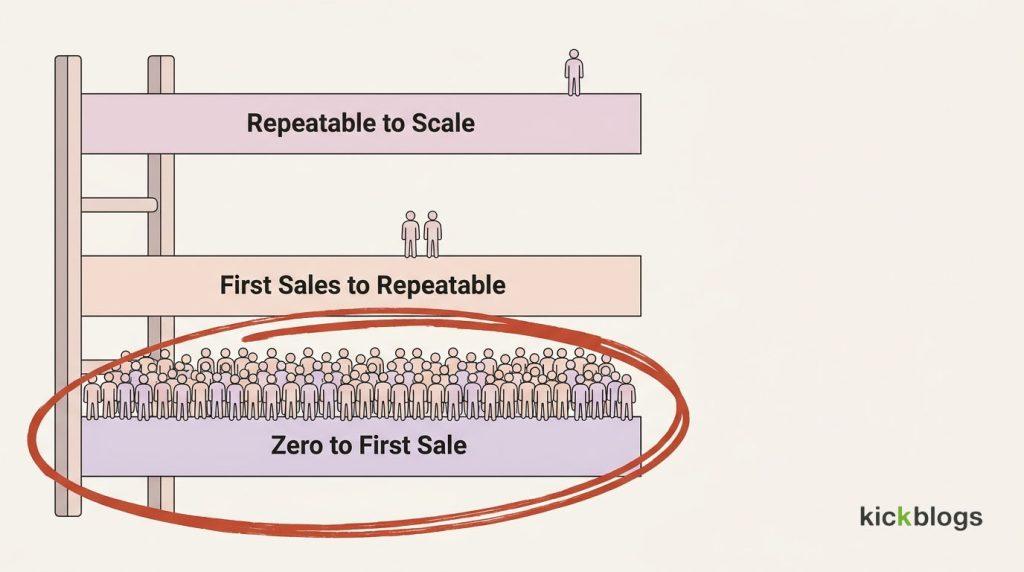
A growth ladder with most people crowded on the bottom rung, zero to first sale
It isn’t. A shop making nothing needs almost the reverse of what a shop making five thousand a month needs. The first one needs its first ten customers. The second one needs to stop hunting for new tactics and wring more out of the ones already working. Same list, completely different job. That is the part the guides skip, and it happens to be the whole game.
So drop the checklist. Growth is a ladder. What follows is how to tell which rung you are standing on, what actually lifts you off it, and what to leave alone until later.
First, Find Your Rung
Before any tactic, work out where you actually are. Most people get this wrong and then burn months solving the wrong problem.
Rung 1: zero to first sale. You have a site, maybe a product, and next to no traffic. Your entire job is getting the first handful of strangers to buy. Nothing else counts yet.
Rung 2: first sales, not yet repeatable. Money is arriving, but you cannot predict it. A good week, then a dead fortnight. The job now is turning luck into a system.
Rung 3: repeatable revenue, ready to scale. You roughly know what next month will bring. The job becomes pouring fuel on something that already burns.
The mistake nearly everyone makes is running Rung 3 tactics on a Rung 1 business. Buying ads to send traffic to a site that converts no one. Hiring help before there is any work to hand over. Building an email list of people who are never going to buy. The tactic is fine. It is just three rungs too early.
Rung 1: Zero to First Sale
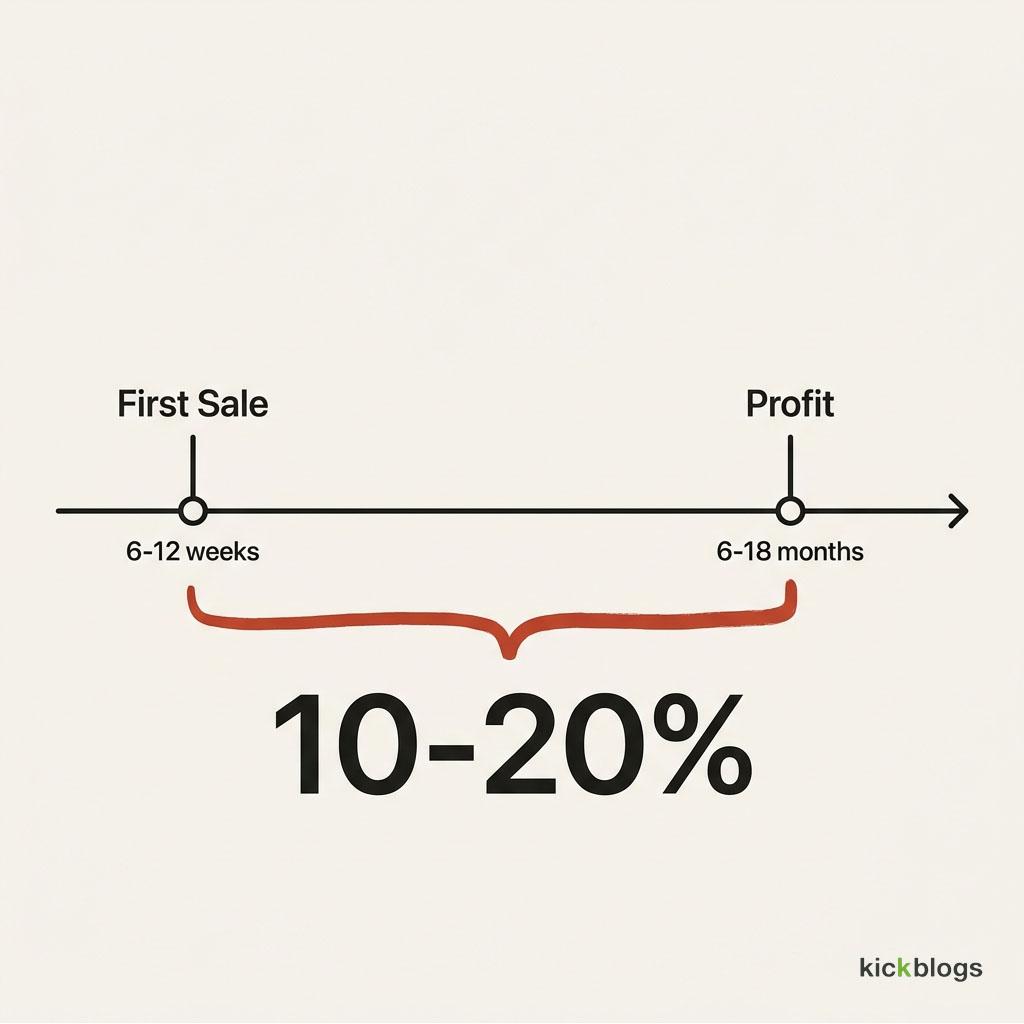
Timeline showing a first sale in 6-12 weeks but profit taking 6-18 months, with only 10-20% profitable in year one.
This is the hardest rung, and the one where most businesses quietly die. Not because the tactics are difficult. Because this stage is slow and silent, and almost nobody warns you how slow.
So here is the honest timeline. A new store can make its first sale in six to twelve weeks if you actively push traffic at it. Profitability, the point where the thing pays you instead of costing you, takes six to eighteen months. Only ten to twenty per cent of new stores turn a profit in year one. Only one to five per cent ever become a business you could live on.
Read those numbers twice, because they explain every failure you have watched from the outside. People rarely quit because the advice was wrong. They quit because they expected month two to look like month twelve.
On this rung, exactly one thing matters: getting real strangers to pay. Everything else is procrastination wearing a productivity costume. Redesigning the logo, opening a fifth social account, reading one more growth guide. None of it moves a stranger’s card any closer to your checkout.
What works here is narrow and a bit boring. Pick the single channel where your buyers already gather and go deep, instead of spreading yourself thin across six. If they search, that is SEO, and it is slow. If they scroll, that is one social platform done properly. If you can reach them directly, a bit of cold outreach or a small paid test will beat waiting on organic. You are not chasing scale yet. You are chasing proof that anyone at all will pay.
A word on SEO specifically, since every guide shoves it to the front. New content ranks slowly. Only about six per cent of new pages reach Google’s first page inside a year. It is worth starting early for exactly that reason, but do not expect it to feed you in the first few months. Think of it as a crop. You plant now and harvest much later.
Rung 2: First Sales to Repeatable
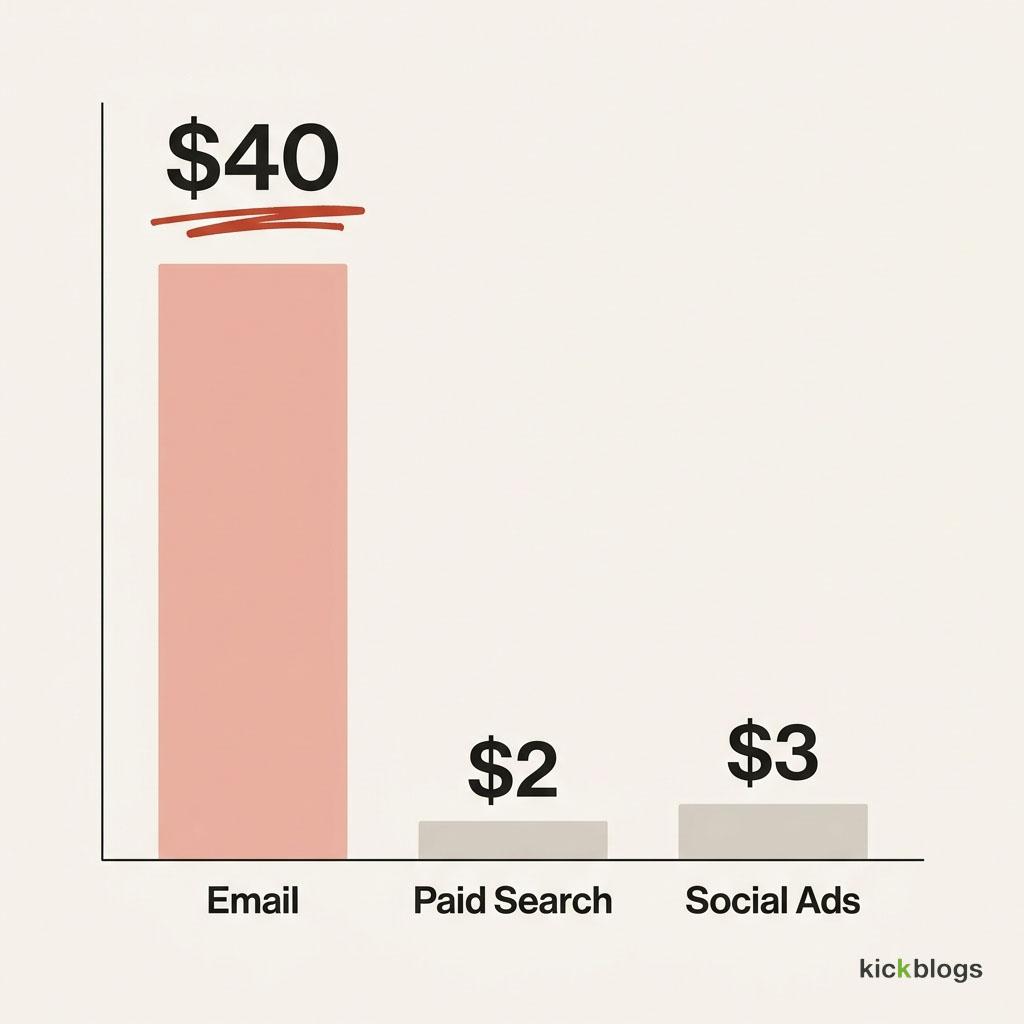
Bar chart: email returns about $40 per dollar spent versus $2-3 for paid search and social ads.
You have proof. Strangers buy. The job now flips completely, and this is where the checklist really comes apart, because most of what felt like progress on Rung 1 turns into a distraction on Rung 2.
Stop chasing new channels. The instinct, the moment something works, is to go find the next thing. Kill that instinct. The money on this rung comes from making your one working channel work harder, and from getting more out of the customers you have already won.
This is where email finally earns its keep, and burying it at the bottom of the original checklist, under influencer outreach of all things, is close to malpractice. Email returns somewhere around thirty-six to forty-two dollars for every dollar you put in, and nearer forty-five in retail.
Paid search runs about two dollars. Social ads, under three. Nothing else on the list is even in the same postcode. A customer who has bought once is the cheapest second sale you will ever make, and email is how you make it.
The work here is unglamorous, which is probably why the guides skip it. Write down what happens when someone buys, so it happens the same way every time. Build the email sequence that turns one purchase into three.
Find the single step in your funnel where people leak out, and plug that before you touch anything else. That is systemising, and it is what turns a lucky month into a dependable one.
Rung 3: Repeatable to Scale
Now, and only now, the tactics the guides list first begin to make sense. You have a business that reliably turns a dollar in into more than a dollar out. Scaling is just feeding it more dollars.
This is when paid advertising earns its place, because you finally know your numbers. If a customer is worth a hundred dollars and costs thirty to bring in, buying more of them is arithmetic. Run that same campaign on a Rung 1 business, and you are paying good money to confirm it does not convert.
Delegation pays off here too. Outsourcing is a Rung 3 move. You cannot hand off work that does not exist yet, and you cannot afford to before the business supports it. Once the machine is running, though, buying back your own hours is about the highest-return thing money can do for you.
Platform choice, influencer deals, the entire grab-bag from the original’s scaling section, all of it lives here, on a business that has proven it can sell. None of it belongs on a business that has not proven that yet.
The Shortcut: Buying a Rung Instead of Climbing It
Here is the option no growth guide mentions, because they all assume you are starting from zero and grinding your way up.
You do not have to start on Rung 1. It is the slowest, quietest, most failure-prone stage there is, the six to eighteen months where most businesses fold before they ever see profit. It is also the one stage you can simply buy your way past.
Established online businesses change hands every day. What you are buying is one that has already cleared the rung that kills everyone else: real traffic, real customers, and often real revenue from the first month it is yours. You skip the plant-and-wait entirely and start on Rung 2 or 3, where the work is systemising and scaling rather than praying for a first sale.
It is not free, and you do not get to be passive about it. You are paying now for the eighteen months you would otherwise spend, and you still have to run the thing once it is yours. But when time is your real constraint rather than money, buying a business that has already survived the deadly rung is the biggest shortcut on offer. Worth knowing it exists before you commit a year to climbing from the bottom.
If you want to see what is actually for sale, the KickBlogs marketplace lists established online businesses across every stage, from starter sites through to businesses with years of trading history.
If you would rather have one built and grown for you, that is what our done-for-you services cover. And if you are still at the very start, our guide on how to make a brand covers the rung below this one.
What to Ignore at Every Stage
Half of growth is knowing what to leave alone. The short version:
On Rung 1, ignore: paid ads at any real scale, hiring, email automation for a list that barely exists, any channel past your first, and logo fiddling. None of it counts before someone pays you.
On Rung 2, ignore: new channels, new products, anything shiny. Your job is depth on what works, not breadth across what might.
On Rung 3, ignore: the urge to stay hands-on. The job here is to remove yourself, not to keep doing the work that got you this far.
The businesses that grow are rarely the ones doing the most. They are the ones doing the right thing for the rung they are on, and calmly ignoring everything else.
Frequently Asked Questions
How long does it take to grow an online business?
Longer than most guides admit. A first sale can land in six to twelve weeks, but profitability usually takes six to eighteen months, and only ten to twenty per cent of new stores are profitable in their first year. The ones that make it tend to be the ones that expected the slow start and did not quit partway through it.
What is the fastest way to grow an online business?
For most people, depth beats breadth: pick the one channel where your buyers already are and go deep, rather than spreading across six. The genuinely fastest route past the slow early stage is to buy a business that is already past it, which skips the six to eighteen months where most new businesses fail.
What actually matters most when growing online?
It depends entirely on your stage. At zero, it is getting any stranger to buy. Once sales start, it is systemising and email. Once revenue is repeatable, it is paid traffic and delegation. Running the right tactic at the wrong stage is the most common and most expensive growth mistake there is.
Is email marketing still worth it in 2026?
Yes, comfortably. Email returns roughly thirty-six to forty-two dollars for every dollar spent, more than ten times what paid search or social ads return. It only works once you have customers to email, which is why it belongs on Rung 2, but from there it is the highest-return channel you have.
Should I buy an existing online business instead of starting one?
If your constraint is time rather than money, often yes. Starting from zero means six to eighteen months on the slowest, most failure-prone stage. Buying a business already past it lets you start where the work is: systemising and scaling, and it lets you check real traffic and revenue before you commit, which building from scratch never does.
Get High-Level Support
How To Use Instagram For Business Without Chasing Followers
Nearly every guide about using Instagram for business opens with the same instruction. Build a…
Buying a Local Business: What Turnkey Really Means
“Turnkey” is the word a seller reaches for when they’d rather you stopped asking questions….

Get More Clicks on Your Google Ads Without Paying More
Most articles on this topic list five or six ways to get more clicks. The…

Starting a Business After The Kids Leave Home
The Victorian Government’s Better Health Channel describes it in language most people would not dare…

You Need To Know This – Before Starting An Online Business
Almost every guide to starting an online business opens the same way. Here are the…
How To Successfully Run A Facebook Page
You should have a Facebook Page. That part of the standard advice is correct, and…
Buy an Established Website vs Build From Scratch: An Honest Comparison
A Shopify subscription costs about forty dollars a month. An established online business costs somewhere…
How to Create Search-Relevant Content in 2026
Search-relevant content answers the exact question someone typed, in the shape they expected the answer…