
Search-relevant content answers the exact question someone typed, in the shape they expected the answer to take. That definition has not changed in twenty years. What changed is who reads it.
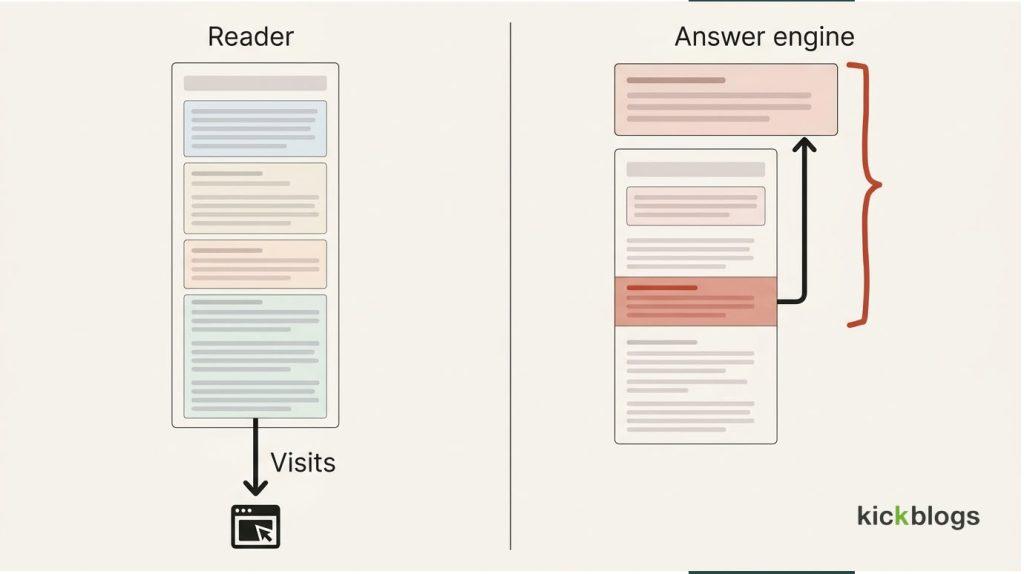
One page, two readers: a person clicks through to the site while an answer engine quotes a passage and sends nobody.
Your page now has two readers, and only one of them clicks. The first is a person. The second is a machine writing a summary above the results, deciding whether to quote you or somebody else.
What Changed Since the Old Checklist Was Written
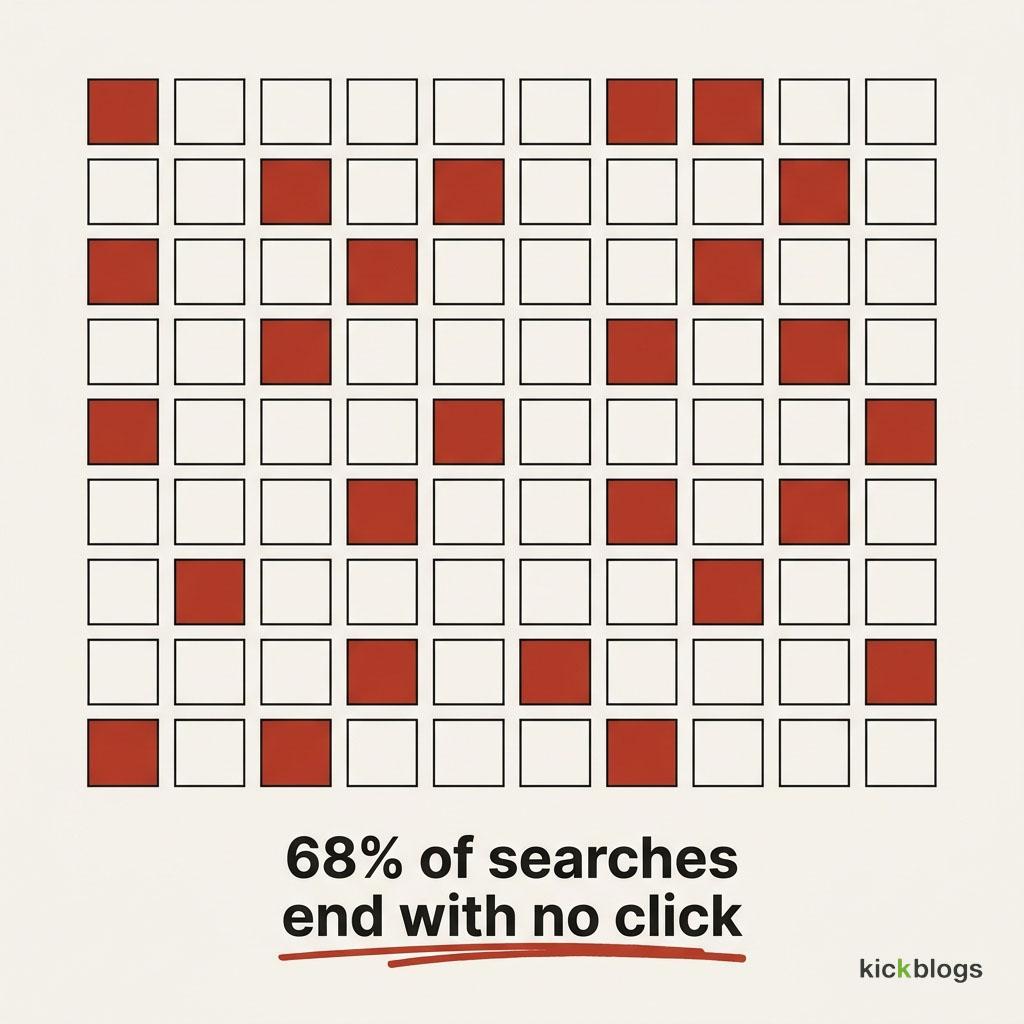
A grid of searches with only a third producing a click, showing roughly 68% ending without one.
Most advice on this topic, including the earlier version of this article, was built to win one thing: a click on a blue link. Pick a keyword, write a page about it, tidy the title tag, wait for traffic.
That model is now the minority case. Search Engine Land reported roughly 68% of US Google searches in early 2026 ended without a click to any website, up from about half in 2019. Where an AI Overview appears on an informational query, one study of 3,119 queries found organic click-through fell about 61%, from 1.76% down to 0.61%.
Most people who find your answer will never visit your site. Write for that, not against it.
Read those numbers carefully, because the obvious conclusion is the wrong one. They do not say rankings stopped mattering. Ahrefs found 38% of AI Overview citations come from pages already sitting in the top 10 organic results. Ranking is still how you get into the room. It is just no longer how you get paid.
So most of the checklist below is the same checklist. Every item on it has picked up a second job. The same shift has repriced every other channel too, which is worth understanding before you decide how much of your week search deserves. We ranked them all in digital marketing tactics by what they actually pay back.
What is your expertise? Create your own content. You write down your stories. Nothing is too niche.
Start With Intent, Not Just Keywords
The old advice was to pick keywords relevant to your business and popular enough that people search them. Both true, both insufficient. Plenty of people have written a perfectly optimised page for a keyword they never had a chance at, because nobody checked what the query actually wanted.
Search intent is the shape of the answer the searcher expects.
| Intent | What they want | Example query |
|---|---|---|
| Informational | To understand something | how to create search relevant content |
| Commercial | To compare before buying | best SEO plugin for WordPress |
| Transactional | To act now | SEOPress pricing |
| Navigational | A specific site | Search Console login |
Get this wrong, and nothing else on the page can save it.
The check that takes two minutes
Type your keyword into Google and look at what already ranks, ignoring the ads.
If the first page is all free how-to guides, that query wants a guide, and a product page will not rank there no matter how neatly you optimise it. If the first page is all product listings, a blog post will not rank either. If an AI Overview is sitting on top, note which pages it cites and what those pages did to earn it.
You are not hunting for a gap in the market. You are reading the brief. Google has already told you what a good answer to this query looks like.
Then ask what you add
Google’s guidance for content creators names information gain: what your page offers beyond what already ranks. Follow the old checklist perfectly, and you produce page eleven, near identical to the ten above it, giving nobody a reason to rank it or cite it.
Your addition can be small. A number you measured yourself. A mistake you made and what it cost you. A step everyone else skips because it is boring. Experience is the part your competitors cannot copy out of the same three sources you both read.
Answer in the First 60 Words
Open the page by answering its core question directly. One tight paragraph, roughly 40 to 60 words, before any preamble.
That serves everyone at once. The person who landed from a search gets immediate confirmation they are in the right place. Featured snippets pull from exactly this kind of block. And analysis of AI Overview citations found roughly 44% of quoted passages come from a page’s introduction, which makes the top of your page the most valuable real estate you own.
The previous version of this article opened with two paragraphs about how SEO can be difficult to understand, before defining anything at all. That is the habit worth breaking.
Then earn the rest of the page by going deeper than the summary. Say the answer, then explain the parts of it that are not obvious.
Structure So Your Answer Can Be Lifted
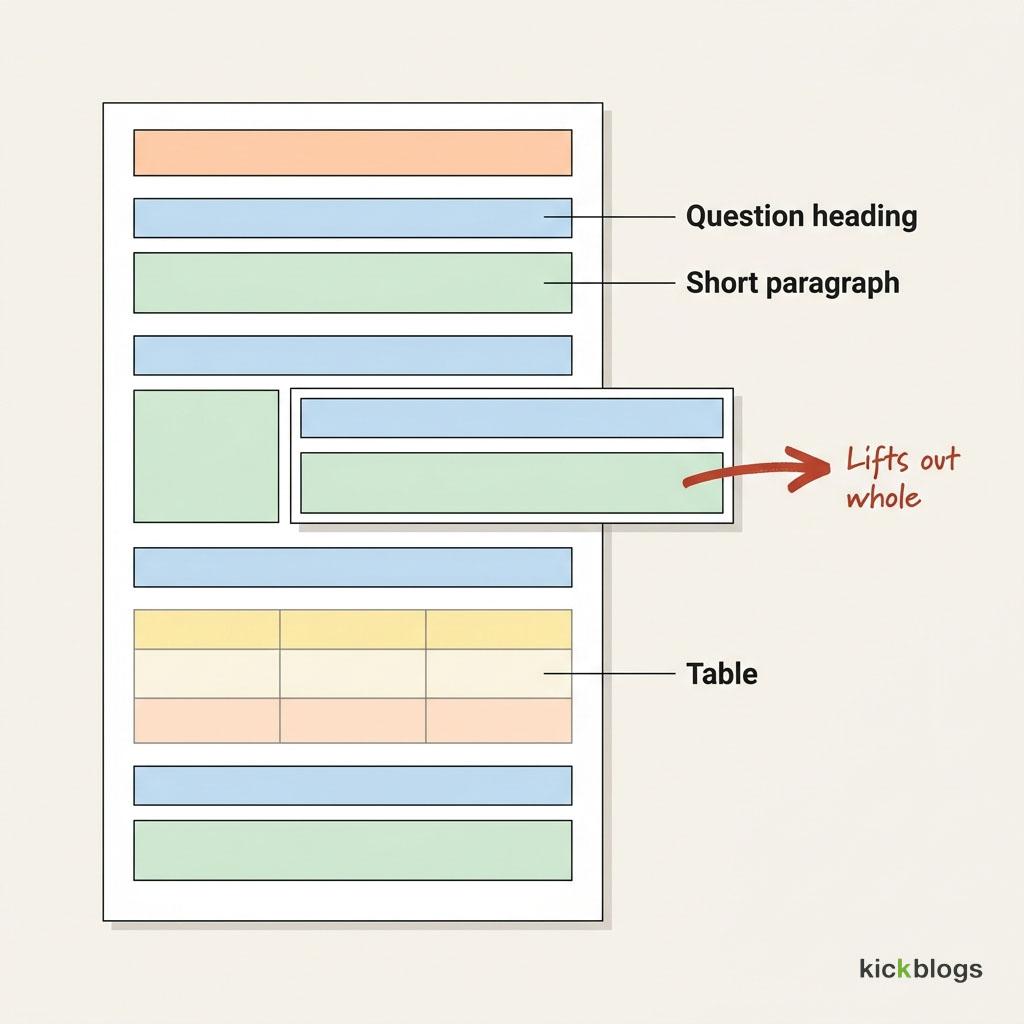
An article page with one self-contained section detached intact, showing how a passage gets lifted and quoted.
Headings, short paragraphs and bullet points used to be a readability nicety. They are now the mechanism by which a machine finds the piece of your page worth quoting.
Write in self-contained passages. If someone lifted one section out of your article and read it with no surrounding context, it should still make sense and still answer something. In practice, that means not leaning on the paragraph above, so no “as mentioned, this is why it works”, and repeating the noun instead of opening a section with a pronoun.
A handful of rules carry most of the benefit:
- Write headings as questions where you can. “How much does alt text matter?” beats “Alt Text”, because the heading matching a real query is half the reason a passage gets found.
- Keep paragraphs to two or three sentences. Long ones bury the liftable bit.
- Use a table for anything comparative. Structured data gets extracted far more reliably than prose, so a table of options or prices earns more than a well-written paragraph saying the same thing.
- Keep heading order logical. One H1, H2’s for sections, H3’s underneath them, and no skipping levels because you preferred the look of it.
- Use lists for anything sequential or countable. Steps, requirements, options.
None of that is padding, and a page built this way is simply easier to read. The formatting advice was always right. The reason behind it got a lot stronger.
Titles and Descriptions: What You Control and What You Don’t
Your page title is still the highest-leverage tag on the page. Keep it under about 60 characters, lead with the thing the query is about, and be specific.
The meta description is a different story now, and the old advice needs correcting. Google rewrites descriptions on a large share of queries, pulling a snippet from your body copy instead. Write one anyway, around 150 to 160 characters, because when it does get used, it decides your click-through. Just stop treating it as guaranteed copy.
Drop the curiosity gap. “Find out why…”, “See more here…”, “Click to reveal…” was standard advice for years. It is now the pattern most likely to get your description binned and replaced, and it does nothing for an answer engine weighing up whether your page is worth citing. Describe what is on the page, plainly. That is the version that survives.
In WordPress, these fields sit in your SEO plugin’s box below the editor. If you have not installed one, SEOPress is light and does the job without taking over your admin.
Images and Links Still Pay, for Better Reasons Than You Were Given
The old line was that search engines cannot read images, so write alt text. That is no longer literally true, because the models reading your page are multimodal. Write alt text anyway, and write it properly, because the real reasons are stronger. Screen reader users depend on it, and it supplies context a caption alone does not.
Describe what the image shows and what it is doing in the article. If a keyword fits naturally, fine. If it does not, leave it out. Alt text stuffed with keywords helps nobody and reads as spam to both audiences.
In WordPress, click the image in the editor and the alt text box appears in the right-hand sidebar.
Links do two separate jobs, and the old advice ran them together. Internal links tell a search engine which of your pages is the authority on a topic, and they route readers deeper into your site. Link from your general pages to your specific ones, using anchor text that describes the destination. How to choose a social media platform is a link. “Click here” is not.
External links to named, credible sources back up what you claim. Pages citing named sources in the body get cited noticeably more often themselves. Linking out has never cost anyone a ranking, whatever you were told in 2014.
What Sits Outside the Page
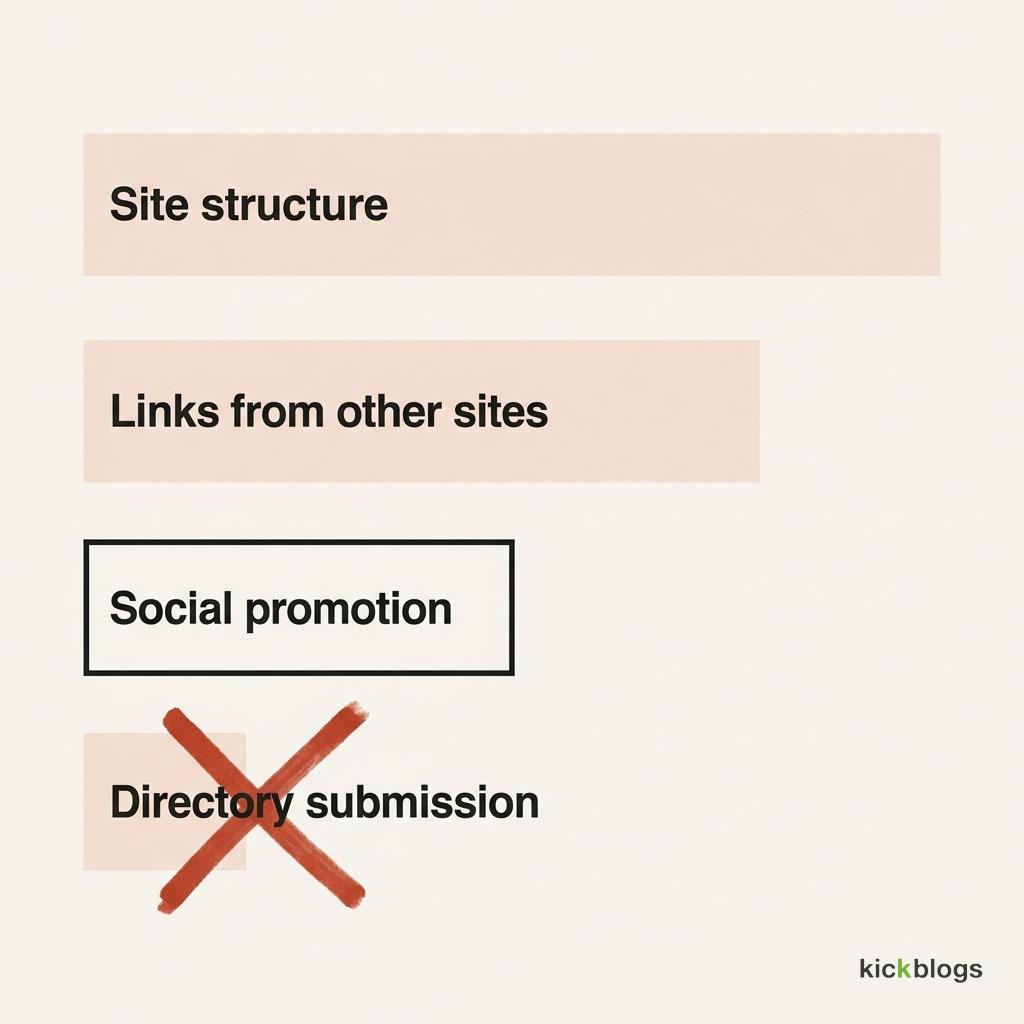
Four off-page SEO factors ranked by impact, with directory submission struck out as no longer worth doing.
Content is most of the job, not all of it. Three things outside your page still move the needle, and one thing does not.
Site structure and navigation come first. If a visitor cannot find what they came for, they leave, and Google gets the message. Clear navigation, sensible URLs, nothing buried more than a couple of clicks from the homepage.
Links from other sites remain a real ranking factor, but the old formula oversimplified it. “More high-quality links means higher rankings” ignores that relevance and trust decide the quality half, and that chasing volume is precisely what has been getting sites penalised for fifteen years. Earn them by being worth citing.
Social promotion is not a direct ranking factor. It is how content gets in front of the people who might link to it, which is the indirect route that actually matters.
Directory submission, though, is dead. If you are working from an old checklist telling you to submit your site to directories and to search engines, delete that step. Google has not needed URL submission for indexing in years, and bulk directory listings have been a liability rather than a benefit for well over a decade.
How to Tell Whether Any of It Worked
We recommended adding your website to “Google’s Search Console” There is a ton of information about how your site performs in the Google search results.
Open the Performance report and read two numbers per page.
| What you see | What it means | What to do |
|---|---|---|
| Low impressions | Google is not showing you for anything | Relevance or authority problem. Recheck intent against what actually ranks |
| Good impressions, low clicks | You are being shown and passed over | Tighten the title and description, or accept an AI Overview is answering above you |
| Impressions falling on a steady page | The query may have changed shape | Check whether an AI Overview appeared for those queries |
Give any change three months before you judge it. Search is slow, and a page that has not moved in three weeks has told you nothing.
If you have impressions and no clicks
This is the defining problem of search right now, and no trick fixes it. What helps: tightening the title so it matches the query more exactly, making the description specific enough to be worth a click over a summary, and going after queries where a two-line answer genuinely is not enough. Anything a machine can fully answer in one sentence was never going to send you traffic for long.
The queries still worth winning are the ones where the reader needs your judgement or your numbers.
Frequently Asked Questions
What does search-relevant content actually mean?
Content that answers the specific question someone searched, in the format they expected. Relevance gets judged against the query and against the pages already ranking, not against your own view of what the topic needs.
Is SEO still worth doing if most searches do not produce a click?
Yes, but measure it differently. Ranking is still how pages get selected for AI Overviews, and 38% of those citations come from the top 10 organic results. What changes is that you should aim at queries where a summary cannot stand in for the page. Whether search deserves your attention at all depends on what stage your business is at, because a shop chasing its first ten customers should not be waiting six months on rankings.
How long should a page be?
As long as the answer needs. Length is a symptom of thoroughness, not a cause of ranking. A 700-word page that fully answers a narrow question beats a 2,500-word page padded out to hit a number.
Do I still need an SEO plugin?
For WordPress, yes, for titles, descriptions and sitemaps. SEOPress or something similarly lightweight is enough. The plugin does not do SEO for you, and no plugin’s green light means you will rank.
How often should I update old content?
When something in it stops being true. A page recommending directory submissions, or naming Search Console by a name it lost in 2015, tells every reader that nobody has looked at it in years.
Should I write for AI search or for Google search?
The same page serves both. Answer-first openings, self-contained sections and question-shaped headings are what make content quotable, and they are also what make it readable.
Getting a professional to build your website is very affordable. Beautiful websites, beautiful prices – that’s what we’re about.
Check out our Portfolio and see the quality of our work and the value that you get.
Get High-Level Support
Buying a Local Business: What Turnkey Really Means
“Turnkey” is the word a seller reaches for when they’d rather you stopped asking questions….

Get More Clicks on Your Google Ads Without Paying More
Most articles on this topic list five or six ways to get more clicks. The…
Starting a Business After The Kids Leave Home
The Victorian Government’s Better Health Channel describes it in language most people would not dare…

You Need To Know This – Before Starting An Online Business
Almost every guide to starting an online business opens the same way. Here are the…
How To Successfully Run A Facebook Page
You should have a Facebook Page. That part of the standard advice is correct, and…
Buy an Established Website vs Build From Scratch: An Honest Comparison
A Shopify subscription costs about forty dollars a month. An established online business costs somewhere…
How To Choose The Best Social Media Platforms For Your Website?
Most advice on this hands you a list of things to consider. Your audience. Your…

Digital Marketing Tactics Ranked by What They Pay Back
Most lists of digital marketing tactics online share the same flaw. They hand you ten…