

Almost every guide to starting an online business opens the same way. Here are the business models. Here is what each one is good at. Then pick the one that suits you.
That’s all well and good. The models are real, and the descriptions are usually accurate. The problem is what that implies. That is, choosing correctly and picking one decides whether any of this works at all.
It does not. Ecommerce, digital products, subscriptions, productised services and content sites do not fail in five different ways. They all fail the same way: nobody arrives at the business.
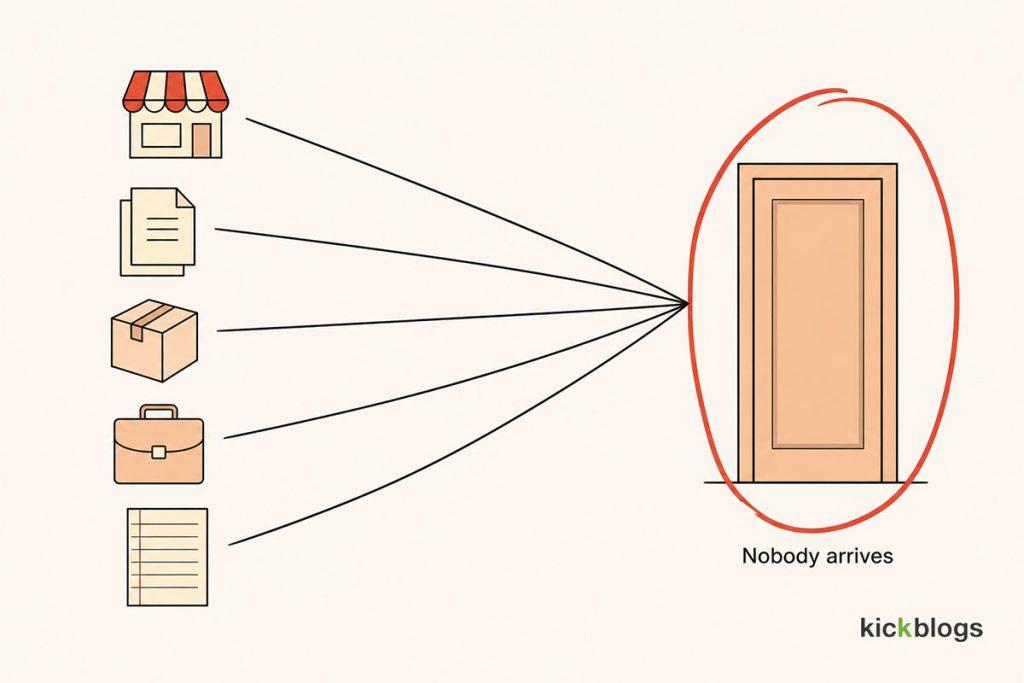
Ahrefs studied roughly 14 billion web pages and found that 96.55% of them get no traffic from Google at all. Not a little traffic, but none. That number does not care which business model the page belonged to.
The models still appear below, because you do have to pick one, and one each now carries a real cost and a real timeline. However, they’re just an input. The decision lies elsewhere, in the two questions that the typical advice never asks.
The Problem Every Model Inherits
An online business needs three things to work. Something to sell, a way to take the money, and people arriving.
Two of those are solved. Shopify will host a store for $56 a month, billed monthly, or $42 on an annual plan, both excluding GST. Stripe will take payments the day you connect it. A digital product can be listed in an afternoon.
The technical build that used to be the hard part is now the easy part, and it feels like progress, which is what makes it dangerous. You can spend six weeks on a logo, a theme and a product page and finish with a business that has done nothing at all.
The third thing has never been solved. It’s where the money goes, and where the years go.
This is why the model comparison misleads. It sets up a choice between five options as though they carry five different risks, when they carry the same one in five different costumes.
The store with no visitors, the course with no launch list, the subscription box nobody signs up to, the freelancer with no leads and the blog nobody reads are the same business at the same point of failure.
Choosing what to sell is a separate problem, and a solvable one. If you’re still at that stage, start with how to work out what business to start, which covers testing whether demand exists before you commit. This page assumes you have a rough idea and are trying to work out what happens next.
The store with no visitors and the blog nobody reads are the same business at the same point of failure.
The model does change three things: how much you spend before you find out, how much you keep from each sale, and how many months pass before the first dollar. Those are the terms you are choosing between.
What the Five Models Actually Differ On
Same taxonomy as every other guide. Numbers against it instead of adjectives.
| Business Models | Setup cost (AUD) | Realistic time to first dollar | Gross margin | Where it stalls |
|---|---|---|---|---|
| Ecommerce, physical goods | $2,000 to $15,000 with stock | 1 to 3 months | 20% to 40% | Cost per order exceeds margin per order |
| Digital products | Under $500 | 1 to 6 months | 85% to 95% | The launch reaches nobody |
| Subscription | As above, plus billing setup | 1 to 3 months | Varies by product | Churn outruns acquisition |
| Productised service | $0 to $2,000 | Days to weeks | High, but capped by your hours | You are the capacity |
| Content and affiliate | $200 to $1,500 a year | 12 to 24 months | Close to 100% of what arrives | It never gets indexed traffic |
Ecommerce and Physical Goods
Most first-time founders choose this one because it’s the most visible version of an online business.
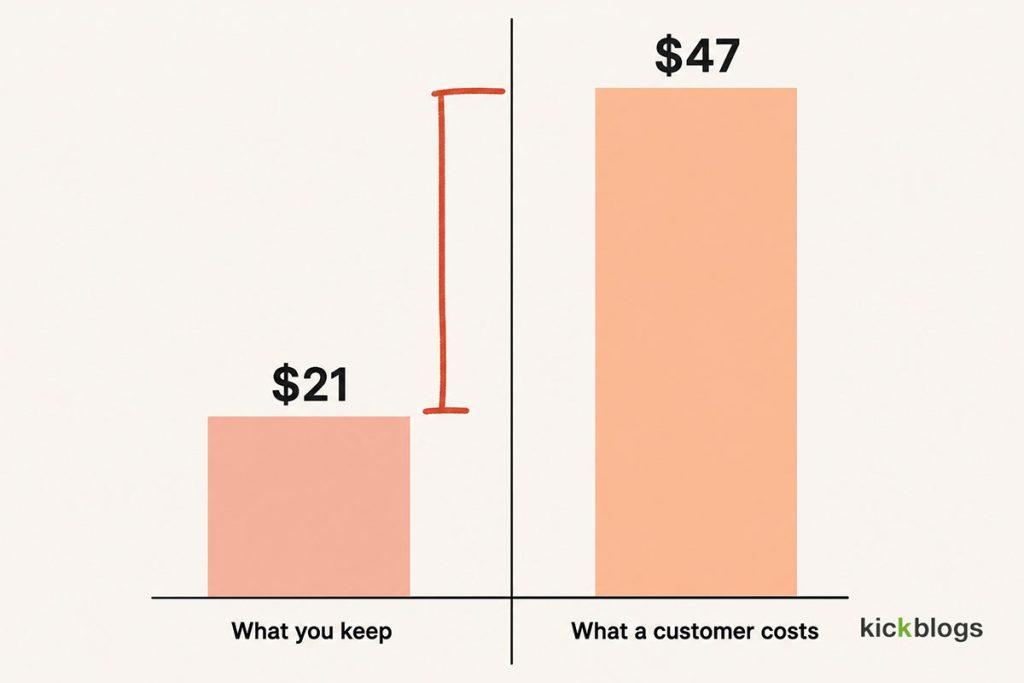
The margin is the constraint. Sell a $60 product at a 35% gross margin, and you keep $21 before you have paid for a single visitor. That $21 is your entire budget for acquiring the customer. It’s usually not enough, and the next section puts a figure on how far short it falls.
Physical goods also carry the only real inventory risk on this list. Stock that does not sell is money you cannot get back, and you commit it before you know whether anyone wants the product.
Digital Products
The margin case is genuine. There is no unit cost, no shipping and no stock, so an ebook, template pack or course keeps 85% to 95% of its price.
The failure mode has nothing to do with the product. Digital products sell in launches, and a launch is a moment when you point an existing audience at an offer. Build the product first, and you arrive at launch day with nothing to point.
The audience is the asset, and the product is the easy part, which is the reverse of how most people sequence it.
Subscriptions
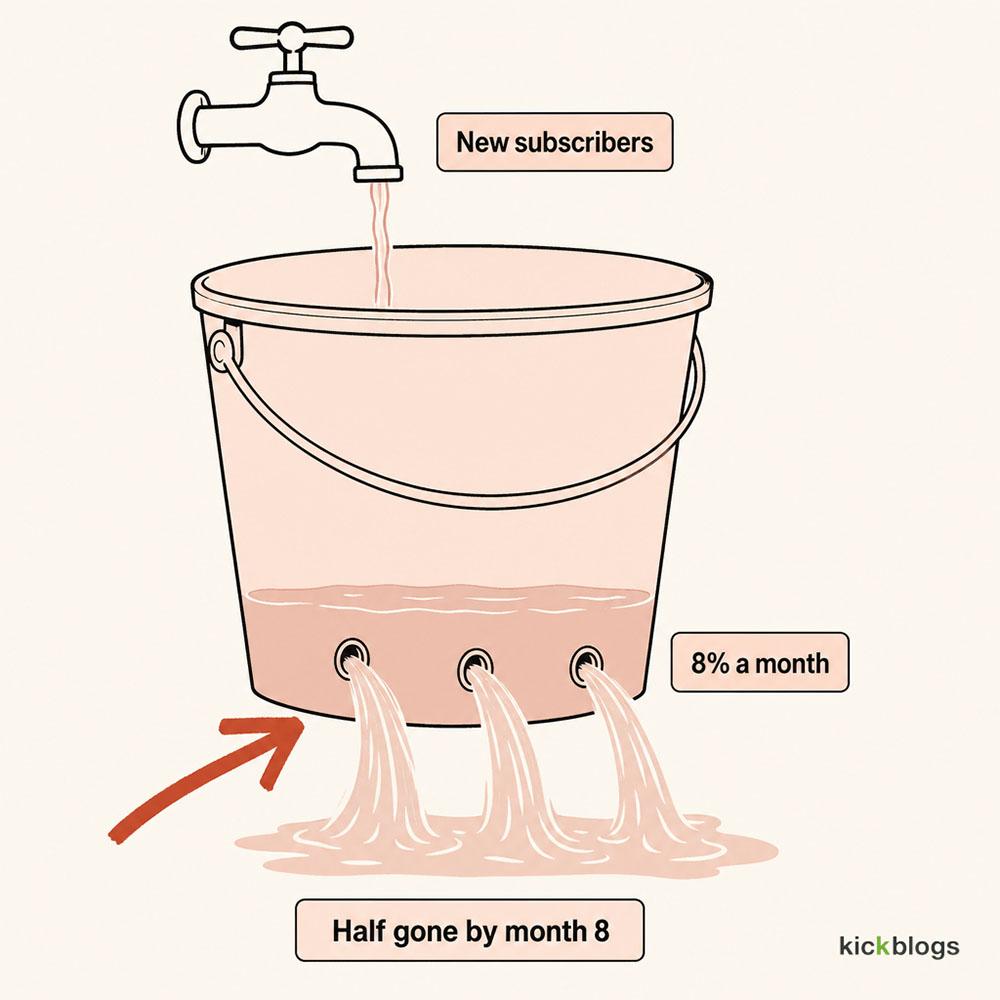
Recurring revenue is why everyone wants this model. It’s also why the model gets misjudged more than any other on the list. Recurring revenue leaks.
Consumer subscription churn in 2026 runs 5% to 8% a month for replenishment products like supplements and pet supplies, and 10% to 15% a month for curated boxes in beauty and apparel.
At 8% monthly churn, you’ve lost half your subscribers in about eight months. At 5%, it takes about fourteen. Every month you’re refilling a bucket before you can start growing it.
Annual billing changes the arithmetic more than any retention tactic will. The same products billed yearly run the equivalent of 0.5% to 1.5% a month. If you build a subscription, sell the year.
Productised Services
This is the least glamorous model on the list. It’s also the only one that can pay you in the first fortnight.
The reason is not that services are easier. Rather, services are the one model where you can go and get a customer directly. You can approach twenty businesses, have four conversations and close one, and no traffic was involved at any point. Every other model here requires people to find you first.
The ceiling is real. Your revenue is your hours multiplied by your rate, and the fix, which is hiring, turns a solo business into a management job. But a service that pays now funds the model that pays later.
Content and Affiliate Sites
Most guides call this the low-risk option because the overheads are small. The overheads are small. The odds are the problem.
Of newly published pages, 1.74% reach Google’s top 10 for any keyword within a year, according to Ahrefs. In 2017, the same measurement was 5.7%. For keywords with more than 10,000 monthly searches, it is 0.3%.
Meanwhile, 72.9% of the pages currently sitting in the top 10 are more than three years old, and pages less than a year old hold 13.7% of those positions.
Content does work. It works on a schedule measured in years, and the schedule is getting longer. Almost none of the cost is money. It’s your time, and time is the one input you cannot buy more of.
Traffic Has Two Prices, and You Pay One of Them
Every model above needs new customers turning up. There are exactly two ways to get them, and each has its price.
The Money Price
Paid traffic is the fast option, and you can know its cost before you spend anything. That makes it the honest place to start.
Across 2,800 Shopify stores measured by Littledata, the average conversion rate is 1.4%. Take that at face value, and roughly 71 visitors produce one order. Google Shopping clicks for ecommerce average about $0.66 in 2026, so those 71 clicks cost about $47 before you have paid for the product, the platform or your time.
WordStream’s 2026 benchmarks reach the same place from the other direction, putting the average ecommerce cost per acquisition on Google search at $45.27. Two methods landing within a couple of dollars of each other are worth taking seriously.
In ecommerce, then, a customer bought with advertising costs somewhere between $45 and $47. Go back to the earlier example. A $60 product at 35% margin returns $21. That business loses money on every order it advertises for, and no amount of optimisation closes a gap that size.
It needs a higher price, a much better margin, or customers who buy more than once.
None of this argument is against paid traffic. The median return on Google Ads spend for ecommerce heading into 2026 is $3.50 for every dollar, so it works for plenty of stores. It’s an argument for doing this multiplication before you choose what to sell, rather than after you’ve bought the stock.
The Time Price
Free traffic is not free. It is deferred, and the exchange rate has moved against you.
68% of Google searches ended without a click in early 2026, according to the study reported by Search Engine Land. When an AI Overview appears above the results, that rises to 83%, and the click-through rate for the first organic position falls from 31.7% to 19.8%.
Ranking and receiving traffic have come apart. You can do the work, earn the position, and still watch the answer get delivered on the results page by something that read your article and didn’t send anyone there.
Put that next to the 1.74% figure and the time price stops being vague. Twelve to twenty-four months of consistent publishing, a low probability of ranking at all, and a smaller click yield if you manage it.
You can do the work, earn the position, and still watch the answer get delivered on the results page by something that read your article and didn’t send anyone there.
None of this makes organic search a bad channel. It remains the only one that keeps working after you stop paying. It does mean that “I will just do SEO” is a plan with a two-year fuse that needs to be costed as one.
The rest of the channels sit between these two prices, and they’re not equal. We have ranked them by what they return and how long they take in our breakdown of digital marketing tactics by payback. The short version is that attempting all of them is the most reliable way to get nothing from any of them.
Two Questions To Answer Before You Build Anything
Neither of these requires a website, and both are worth more than the six weeks most people spend choosing a theme.
Where Do the First Hundred Arrivals Come From?
Answer this with names, not channels. “Social media” is not an answer. “SEO” is not an answer. The answer sounds like: the 340 people in this Facebook group, the mailing list at the club I have belonged to for six years, the forty local businesses I can email because I worked in that industry.
If the honest answer is that you do not have one, that is useful information, and it arrived before you spent anything. It points to two options. Build the audience first and the product second, which is slow but works. Or pick the service model, where you can go directly to customers instead of waiting for them.
The one thing it shouldn’t do is building the store anyway and hoping. That’s the path the 96.55% are on.
How Many Months Can You Go Without Revenue?
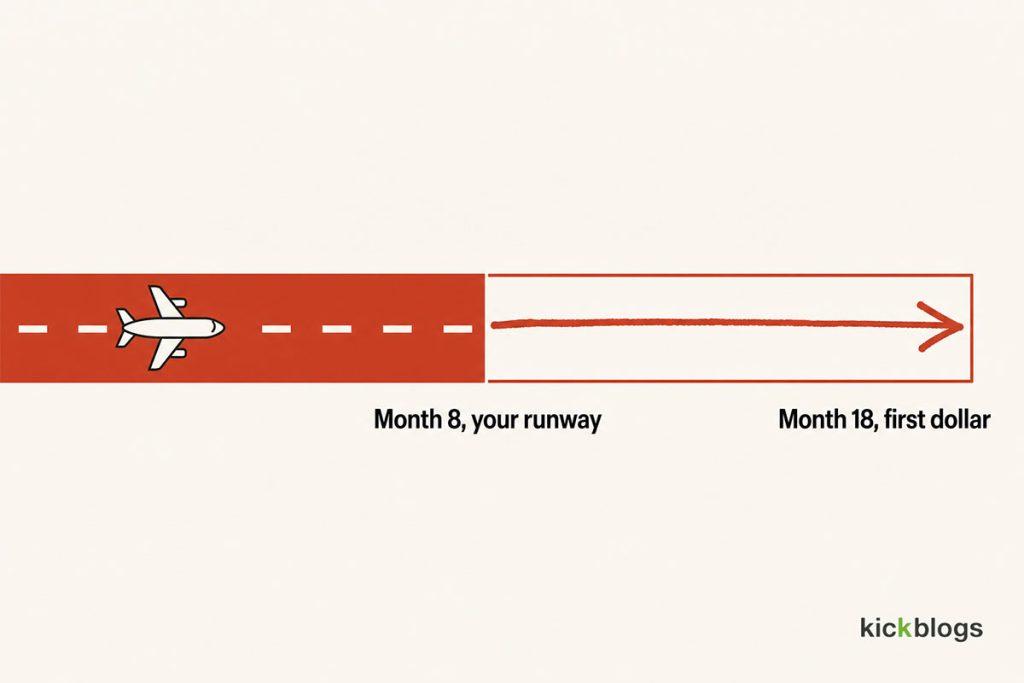
Work out the real figure. Savings, plus whatever income continues, divided by what you spend each month. Most people arrive at six to twelve months and have never written it down.
Now compare it against the “time to first dollar” column in the table. A content site takes twelve to twenty-four months to pay. If your runway is eight months, that model is not available to you no matter how well it suits your interests. Choosing it anyway means running out of money at month eight and calling it a failure of effort.
Time: an afternoon. Cost: nothing but honesty.
This is where the model choice gets made. Appeal has nothing to do with it. The only question is which model pays inside the runway you have.
Start With the Model That Pays First
Services pay in weeks and require no traffic, because you can approach customers directly. Products need volume, and volume needs either money or months. So the sequence that survives contact with a real bank balance is to earn with a service, use that income to buy the runway, and build the model that scales while something else is paying the bills.
It is unglamorous, and it’s what most durable online businesses did. The version where someone builds a store, it works immediately, and they never trade time for money exists, but it is the exception that gets written up precisely because it’s rare.
If you’ve already decided on a product business, the ordering still applies inside it. Build the audience before the product. A mailing list of 500 people who asked to hear from you is worth more on launch day than a finished course and no one to tell.
What comes after the first revenue is a different question with a different answer at every stage, and we have set it out separately in the stage-by-stage guide to growing an online business.
The Australian Part
Most guides on this topic are written for a US reader and quietly assume US structures. Three things are different here, and none of them is difficult.
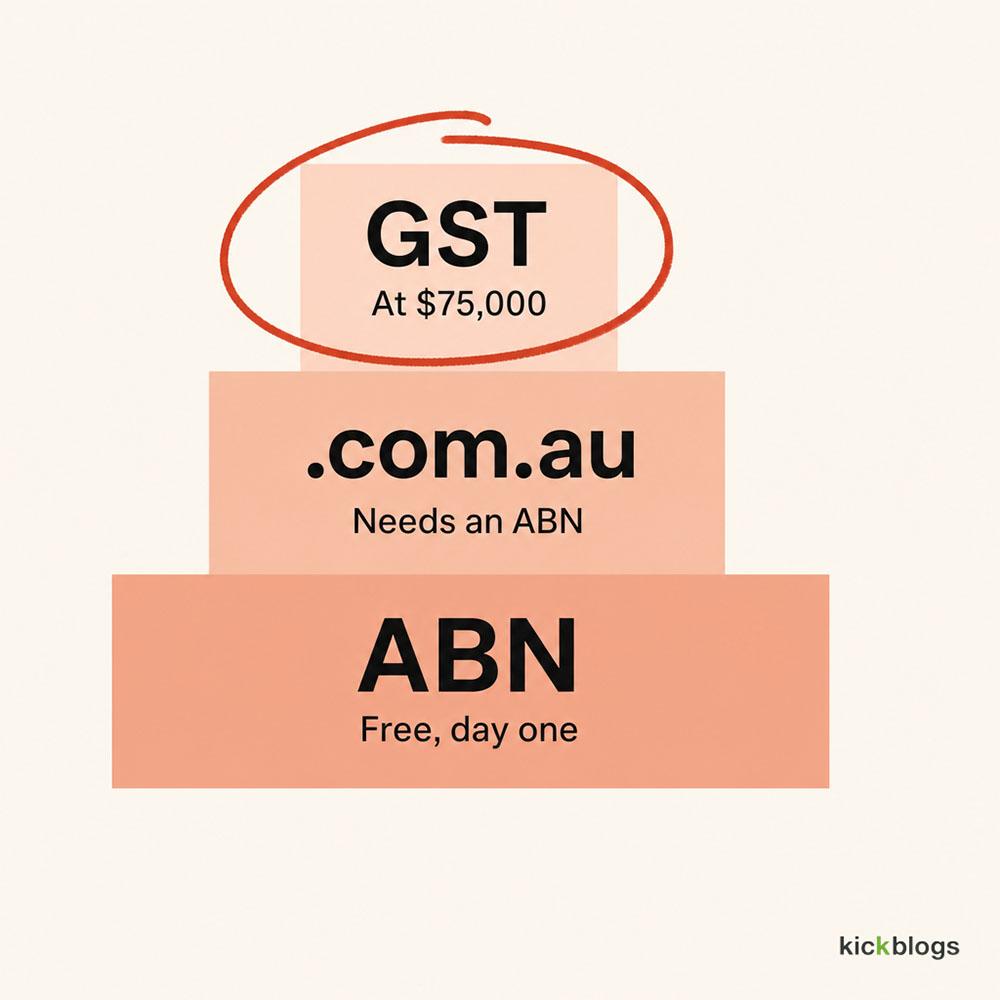
An ABN is free. You apply through the Australian Business Register, and it costs nothing, so any service charging you for one is charging you for the form.
GST registration becomes compulsory once turnover reaches $75,000. Below that, it’s optional. Registering early lets you claim GST back on purchases but commits you to a quarterly BAS, so it’s a genuine decision rather than a formality.
A .com.au domain requires an ABN or ACN. You can’t hold one without an Australian business number, and the name has to relate to your business. For anyone selling to Australians, the small amount of admin pays for itself, because the local extension carries trust that a .com does not.
Business structure, whether to stay a sole trader or incorporate through ASIC, is worth an accountant’s hour rather than an article’s paragraph. That hour costs very little, and this is the one place where getting it wrong is expensive to undo.
The Version Where the Arrivals Already Exist
Everything on this page describes the same gap. The build is quick, the arrivals are slow, and most businesses die in the space between them.
There is one way to skip that gap. It’s also what this marketplace sells, so read the next two paragraphs with that in mind.
Buying a site that already trades means buying the part that takes the years. The domain history, the indexed pages, the rankings that put it in the 3.45% getting traffic at all, and a revenue record you can check rather than forecast. You are not paying for the website. Websites are relatively cheap. You are paying for arrivals that already happen.
It’s not the right answer for everyone. It requires capital you might not have. It also requires the patience to read a seller’s numbers properly and the nerve to walk away from a listing whose traffic is one algorithm update from disappearing. Plenty of readers are better off building, particularly anyone who already has an audience or a service they could sell on Monday.
If you’ve been circling the model question for months, the thing to notice is that the question was never which model. It was where the people come from. That’s the thing to buy, borrow or build first. Everything else on this page is downstream of it.
You can see what is currently listed on the KickBlogs marketplace, and if you would rather work through the decision with people who have already done it, the Owners Club exists for that.
Frequently Asked Questions
What do I need to budget for before starting an online business in Australia?
Less than most people expect for the build and more than most expect for the traffic. A Shopify store runs $42 to $56 a month excluding GST, an ABN is free, and a domain is under $50 a year. The real spend is customer acquisition, which averages around $45 per ecommerce sale on Google Ads. Budget for arrivals, not for setup.
Which online business model is the most profitable?
By margin, digital products at 85% to 95%. By speed to revenue, productised services, which can pay inside a fortnight. Neither is profitable without customers, and that is the actual variable. The most profitable model for you is whichever one pays before your runway runs out.
How long does it take an online business to make money?
It depends entirely on the model. A service can bill in the first two weeks because you approach customers directly. Ecommerce with paid traffic can produce orders inside a month, though rarely profitable ones at first. A content or affiliate site typically takes twelve to twenty-four months, and Ahrefs data shows only 1.74% of new pages reach the top 10 within a year.
Do I need an ABN to start an online business?
To trade properly in Australia, yes, and it is free to apply for through the Australian Business Register. You also need one to register a .com.au domain. GST registration is separate and only becomes compulsory once turnover reaches $75,000, so most new businesses start with an ABN alone.
Is starting a blog still worth it in 2026?
As a business on its own, it is a slow bet that has gotten slower. 96.55% of pages get no Google traffic, 68% of searches end without a click, and pages under a year old hold 13.7% of top-10 positions. As an audience-building layer under a product or service that already sells, it still earns its place.
Should I build a website or buy an existing one?
Build if you have an audience, a service you can sell now, or more time than money. Buy if you have capital and want the traffic and trading history that take years to create. The honest comparison, including where buying goes wrong, is in our guide to buying an established website versus building from scratch.
Get High-Level Support
How To Use Instagram For Business Without Chasing Followers
Nearly every guide about using Instagram for business opens with the same instruction. Build a…
Buying a Local Business: What Turnkey Really Means
“Turnkey” is the word a seller reaches for when they’d rather you stopped asking questions….

Get More Clicks on Your Google Ads Without Paying More
Most articles on this topic list five or six ways to get more clicks. The…
Starting a Business After The Kids Leave Home
The Victorian Government’s Better Health Channel describes it in language most people would not dare…
How To Successfully Run A Facebook Page
You should have a Facebook Page. That part of the standard advice is correct, and…
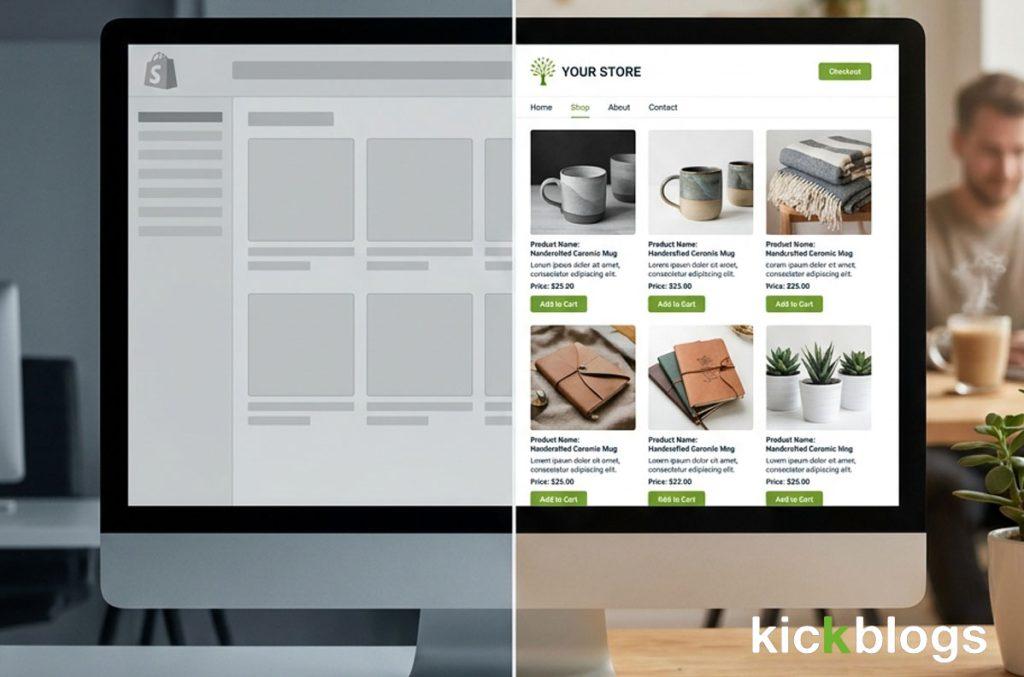
Buy an Established Website vs Build From Scratch: An Honest Comparison
A Shopify subscription costs about forty dollars a month. An established online business costs somewhere…
How to Create Search-Relevant Content in 2026
Search-relevant content answers the exact question someone typed, in the shape they expected the answer…
How To Choose The Best Social Media Platforms For Your Website?
Most advice on this hands you a list of things to consider. Your audience. Your…