
Most advice on this hands you a list of things to consider. Your audience. Your business type. Your competitors, your goals, your budget.
All relevant, and none of it adds up to a decision. You can weigh five factors for a fortnight and still be no closer to opening an account.
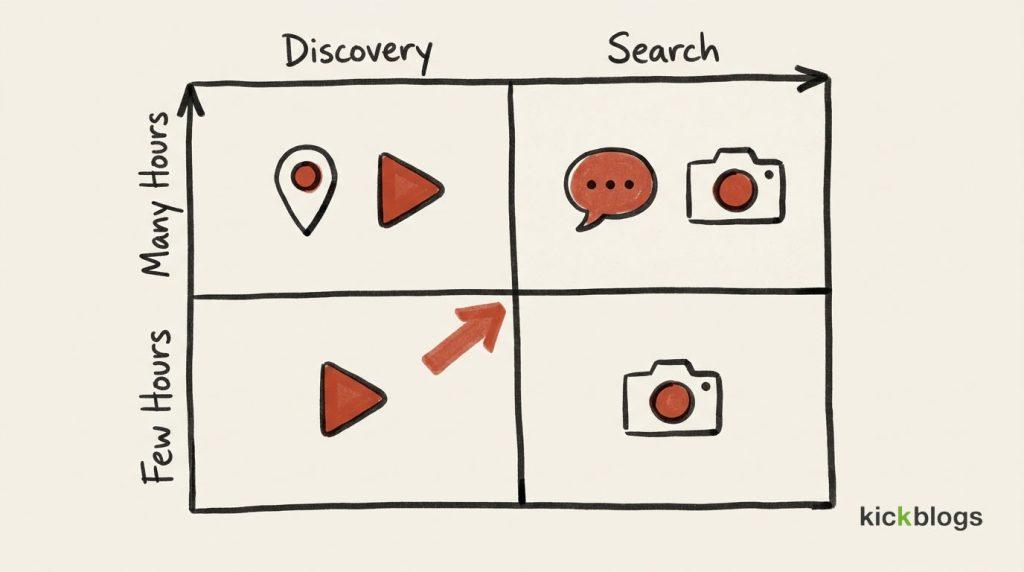
A two-by-two grid choosing a social platform by whether buyers search or discover, and by available hours.
Two questions settle it. Everything else is detail, and there is a way to check your answer before you sink three months into the wrong one.
The Distinction That Decides It: Stream or Search
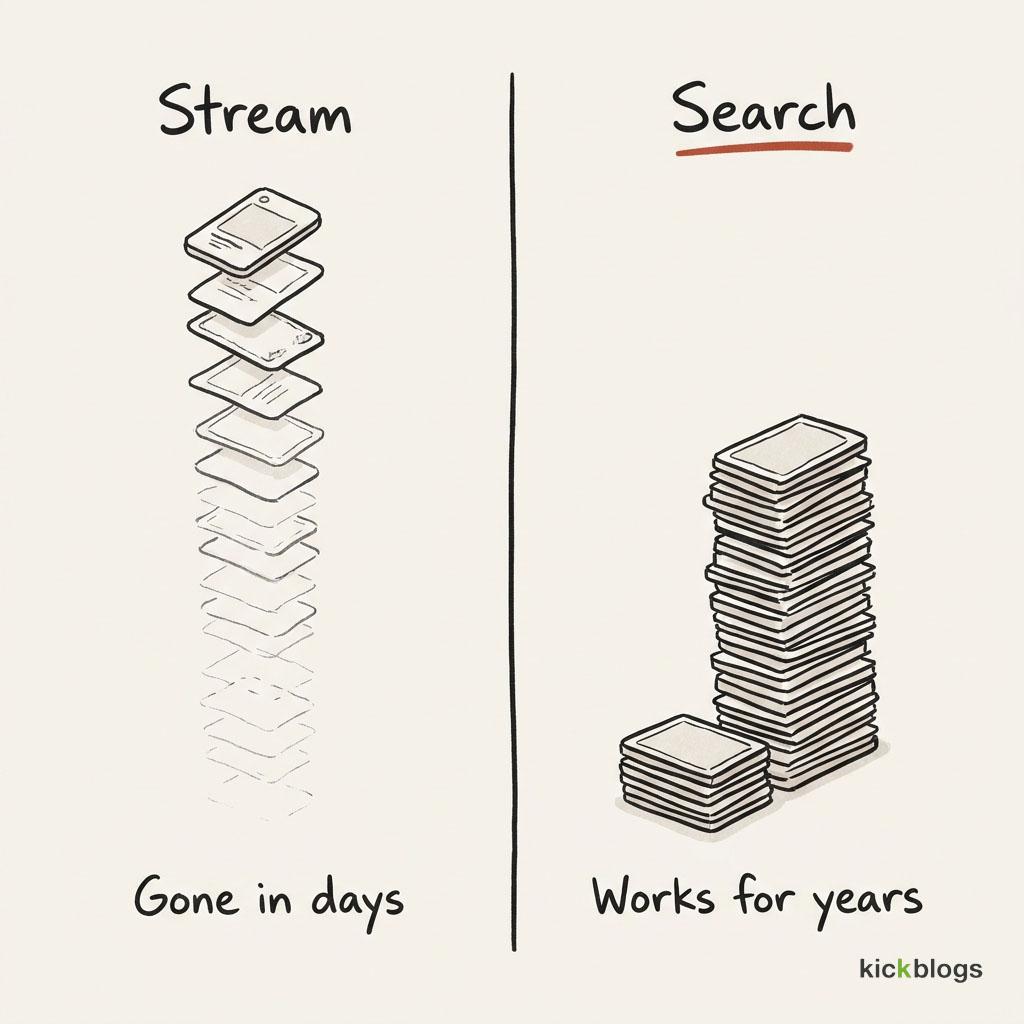
Stream content fades away within days while search content accumulates and keeps working for years.
One structural fact first, because most platform guides skip it and it changes everything downstream.
Social platforms come in two kinds, and they behave nothing alike.
Stream-based platforms push content down a moving feed. Facebook, Instagram, TikTok, X. People scroll, something catches them, it passes. You get genuine social reach and fast feedback. You also get a post that is effectively dead within a day or two, and nothing you made last month is doing anything for you today.
Search-based platforms are where people arrive with a question. YouTube and Pinterest are the main two, and they behave far more like Google than like a feed. Fewer people file them under “social” at all, which is a large part of why they stay undervalued.
The consequence is the bit worth holding onto. On a stream platform you are renting attention, and the rent falls due again tomorrow. On a search platform you are building something that keeps working. A YouTube video or a Pinterest pin can still be pulling views and clicks three years on. The same afternoon spent on a feed post bought you about two days.
That does not make search platforms automatically correct. It does mean the two types ask for completely different commitments, and picking between them is the first real decision you make.
Question One: Do People Search for What You Sell?
This is the fork in the road.
Some things people go looking for. How to fix a leaking tap. Wedding table settings. A recipe for eight. If you sell into that, you have a search-shaped business, and search-based platforms will compound for you in a way a feed never will.
Other things nobody searches for but plenty of people respond to on sight. A new drink brand. A homewares range. A style of jewellery they did not know existed. That is a discovery-shaped business, and it wants a stream platform, where the job is stopping the scroll.
The test takes ten minutes. Type what you sell into YouTube and Pinterest as though you were a customer rather than the owner. Hundreds of videos and pins with real view counts mean people are searching. Almost nothing means either the demand is not there or you have found an actual gap, and the way to tell which is whether anyone is spending money against those terms.
Most businesses lean one way rather than sitting neatly in a box, and leaning is enough. You only need to know which side of the fork you are standing on.
Question Two: How Many Hours Do You Actually Have?
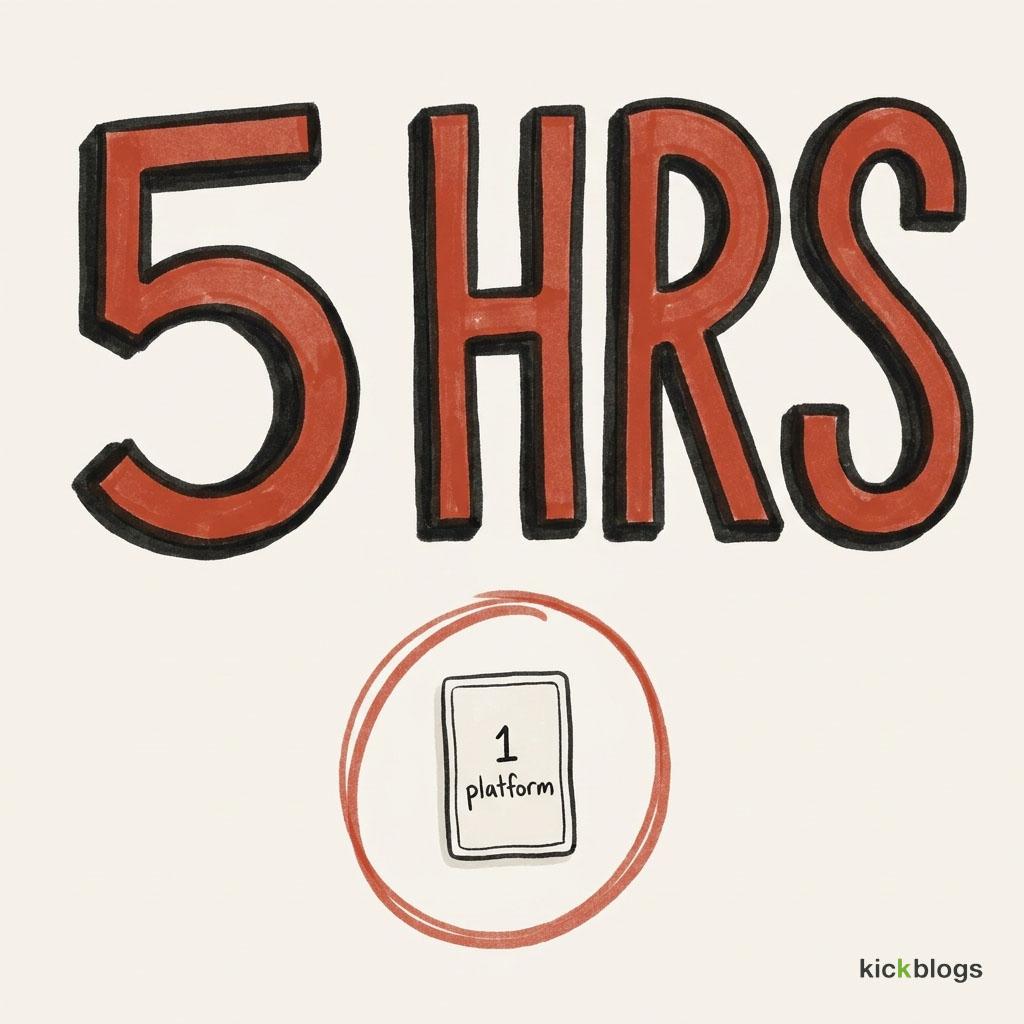
Five hours a week supports one social media platform properly, not four.
The second question is the one people answer dishonestly, and it is where most platform strategies quietly die.
Social media is not a task you finish. It is a standing commitment that wants feeding every week, indefinitely. So the binding constraint is never which platform is best. It is how many you can keep up without abandoning the lot of them by March.
The rough arithmetic, and it is rougher than anyone selling social media services will tell you. Five hours a week supports one platform, properly. Ten to fifteen supports two. A genuinely full-time person can carry three or four. Under five hours, you do not have a channel; you have occasional posting and optimism.
Which means: if you have five hours and accounts on four platforms, you do not have four channels. You have four dormant profiles, each quietly telling anyone who checks that you gave up.
Answer honestly, then let the number cap the ambition. One platform run properly beats four run badly, and the margin is not small.
That argument sits inside a bigger one about which marketing tactics are worth your time at all, where social is one option among several rather than a given.
Check Before You Commit
Almost every version of this article, including the one this replaces, skips the step that matters most. Everything above assumes you know where your audience is. You probably do not, and the assumptions people carry around tend to be a few years out of date.
Look at what the 2026 numbers actually say.
- TikTok’s largest age group is 25 to 34, not teenagers, and its over-35 segment is growing roughly three times faster than Instagram’s.
- Pinterest is about 70% women, which makes it a completely different proposition depending on what you sell.
- LinkedIn holds around 65 million decision-makers and 10 million C-level users, with roughly a third of its US members earning six figures.
Anyone who picked a platform on instinct a few years ago is probably carrying at least one belief from that list that has since stopped being true.
Three ways to check, cheapest first.
Ask your existing customers which platforms they actually use. Ten real conversations beat any demographic table, because they are about your buyers rather than everyone’s.
Search your own category on the platform you are weighing up, and look hard at whether genuine engagement exists or whether it is just brands talking to other brands. Those look similar at a glance and are nothing alike.
Check your competitors are not merely present but getting real responses. A neglected competitor account proves nothing except that someone once opened it.
That is an afternoon of work. Skipping it costs three months.
Then Run It as an Experiment
Once you have chosen, commit properly and treat it as a test with a closing date.
Two to three months, one platform, posting more often than feels comfortable. Several times a week at the low end, daily if you can manage it. Sporadic posting tests nothing at all, because a feed that goes quiet gets deprioritised, and the only thing you learn is that inconsistency does not work, which you knew.
Set the success criterion before you start, and make it something other than followers. Follower count is the easiest number to move and the least connected to money. Better questions: did anyone arrive at your site from it, and did any of them buy or get in touch? A thousand followers who never visit is a worse outcome than fifty who do.
At the end of the window, actually decide. Keep it, or drop it and test the other side of the fork. The one thing you cannot do is let it drift on unresolved, which is precisely how businesses end up with four half-tended accounts and no idea which of them is working.

Frequently Asked Questions
Which social media platform is best for a small business?
The one your buyers already use, and you can sustain. If people search for what you sell, a search-based platform like YouTube or Pinterest compounds over years. If they discover it rather than seek it out, a stream platform like Instagram or TikTok suits better. Your available hours decide how many you run, and for most small businesses that number is one.
Should I be on every social media platform?
No. Five hours a week supports roughly one platform properly, and profiles you cannot maintain work against you, since an abandoned account reads worse to a prospective customer than no account at all.
Is LinkedIn only for B2B?
Mostly, and it is about who is there rather than what the platform is for. LinkedIn holds around 65 million decision-makers and skews heavily towards high earners, which makes it strong for anything sold to businesses or to professionals with money to spend. For most consumer products, the same effort goes further elsewhere.
How long before social media works?
Give it three months before judging a platform, and only if you have posted consistently throughout. That is the argument for picking one and committing: three platforms tested half-heartedly tell you nothing reliable about any of them.
What if my competitors are on a platform I do not want to use?
Check whether it is genuinely working for them before copying it. Look at whether their posts draw real replies and shares, not merely whether the account exists. Plenty of businesses keep accounts running out of obligation, and following them in on that basis just means inheriting their mistake.
We hope this article is helpful.
Get High-Level Support
How To Use Instagram For Business Without Chasing Followers
Nearly every guide about using Instagram for business opens with the same instruction. Build a…
Buying a Local Business: What Turnkey Really Means
“Turnkey” is the word a seller reaches for when they’d rather you stopped asking questions….

Get More Clicks on Your Google Ads Without Paying More
Most articles on this topic list five or six ways to get more clicks. The…
Starting a Business After The Kids Leave Home
The Victorian Government’s Better Health Channel describes it in language most people would not dare…

You Need To Know This – Before Starting An Online Business
Almost every guide to starting an online business opens the same way. Here are the…
How To Successfully Run A Facebook Page
You should have a Facebook Page. That part of the standard advice is correct, and…
Buy an Established Website vs Build From Scratch: An Honest Comparison
A Shopify subscription costs about forty dollars a month. An established online business costs somewhere…
How to Create Search-Relevant Content in 2026
Search-relevant content answers the exact question someone typed, in the shape they expected the answer…